If you’ve landed here, you’re probably tired of reading the same surface-level platform comparisons that don’t actually help you decide anything. “Shopify is great for e-commerce!” “Showit is beautiful but not for shops!” “Just use what feels right!”
Ugh, no thanks. None of that tells you what you actually need to know.
You’re trying to figure out which platform supports how you actually sell — and most comparison articles completely miss that distinction.
So let’s break this down differently. Not with a pros-and-cons list that leaves you more confused than when you started, but with a strategic framework that helps you make the right decision for your business model, your conversion structure, and your actual revenue goals.
“Showit vs Shopify” is one of the most searched questions in the creative small business space — and for good reason.
It’s also one of the most oversimplified answers you’ll find online.
But they usually focus entirely on technical capability instead of business model.
Which platform has more features?
Which one is “easier”?
Which one do other people in your industry use?
So before we dive into platform specifics, I want you to consider what happens when you shift the question entirely.
The Real Question You Should Be Asking (It’s Not About the Platform)
Instead of asking “Which platform is better?” — let’s ask:
Where does conversion actually happen in your business?
This is the question that changes the final decision for your shop!
Because once you understand where trust gets built, where hesitation gets resolved, and where buying decisions actually happen, the platform choice becomes much clearer.
Do your products sell themselves — or do they need context, education, and trust-building before someone clicks “add to cart”?
Are you product-first, experience-first, or hybrid?
Let me explain what I mean by this:
Product-first businesses are built around the product grid.
Customers know what they’re looking for, they browse, they add to cart, they checkout.
Think: established brands with straightforward products, clear categories, and customers who need minimal convincing.
The site’s job is to showcase efficiently and get them to checkout smoothly.
Experience-first businesses are built around storytelling, education, and trust.
Conversion happens before the product page — often on landing pages, blog content, or service descriptions.
The products or services exist, but they need context.
Think: coaches selling programs, creatives selling courses, service providers adding digital products.
Hybrid businesses need both.
They have products that benefit from strategic context, educational content that supports buying decisions, and a brand experience that can’t be templated.
Think: photographers selling both sessions and digital products, designers offering templates and courses, wellness brands with both physical products and memberships.
This distinction matters more than any feature comparison ever will.
Because here’s the thing: both Shopify and Showit are excellent platforms.
But they’re built for fundamentally different conversion models.
And trying to force your business into the wrong model is what creates all that friction you’re feeling.
When Shopify Is the Better Choice
Let’s start with where Shopify truly excels — because I’m not here to convince you that one platform is universally better. I’m here to help you make the right choice for how you actually sell.
Shopify is an excellent platform when:
Your business is product-forward.
Your site’s primary job is to showcase products efficiently and move people to checkout.
You’re not relying heavily on long-form storytelling, educational content, or service-based offers that need extensive landing pages to convert.
You don’t need extensive blogging or content infrastructure.
If your marketing happens primarily on social media, email, or paid ads — and your website exists mainly to fulfill orders — Shopify’s focused approach is a strength I would highly suggest you lean on!
Your products don’t require much context to sell.
Customers understand what you’re selling relatively quickly.
They don’t need extensive education, multiple touchpoints, or narrative-led conversion.
Design flexibility within Shopify is enough for your brand.
Shopify’s theme ecosystem has come a long way. If you can find a theme that represents your brand well (or you’re working with a developer who can customize within Shopify’s structure), you might not need the complete design freedom that Showit offers.
You want Shopify’s built-in infrastructure.
Abandoned cart recovery, discount codes, customer accounts, and inventory management — all native to the platform without needing additional plugins or integrations.
But a BIG note here: They do offer apps, and you might need to buy/pay for some, and they are sometimes more expensive than planned, so research!
In my opinion, Shopify isn’t limiting — it’s just focused.
And for the right business model, that focus is actually a strength!
If you don’t need narrative-led conversion, landing pages or sales page, if you don’t have services to sell alongside products, if you’re not planning to build a content-heavy site with custom landing pages for every offer — Shopify standalone can be a great fit.
Especially for shops that don’t plan to expand into services, education, memberships, or hybrid offers that require more flexible page structures.
Your brand relies on messaging, storytelling, and trust.
Conversion doesn’t happen at the product grid — it happens before that.
On your about page. In your blog content. Through strategic landing pages that position your offers and build confidence before someone ever sees a price.
You sell services + products, or you’re planning to.
Hybrid businesses need flexibility.
You might be a photographer selling both sessions and presets. A designer offering templates and courses. A coach with programs and digital downloads. Shopify wasn’t built for this kind of business model.
You sell digital products, education, or memberships.
These require different structures than physical product shops — often with content delivery, access control, and member portals that need to integrate seamlessly with your brand experience.
Conversion happens before the product grid.
Your customers need to understand your methodology, trust your approach, or see themselves in your brand story before they’re ready to buy.
This requires landing pages, custom layouts, and narrative-led structures that Shopify themes don’t easily support.
You want full design control without Liquid code.
Showit gives you complete visual freedom without needing to be a developer. Every pixel is customizable. Every page can have its own structure. This matters when your brand is your differentiator.
Let me share a real example that challenges the assumption that a big shop should immediately go with Shopify:
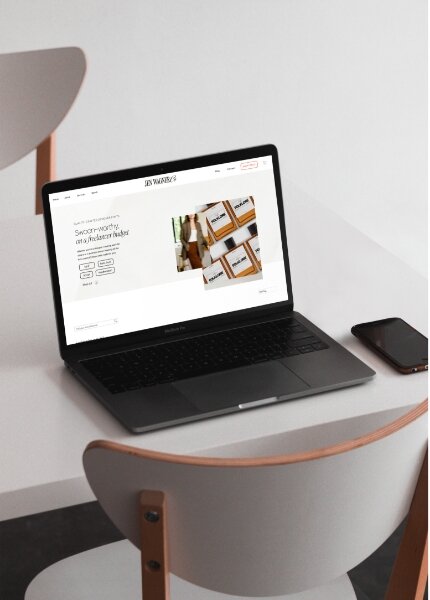
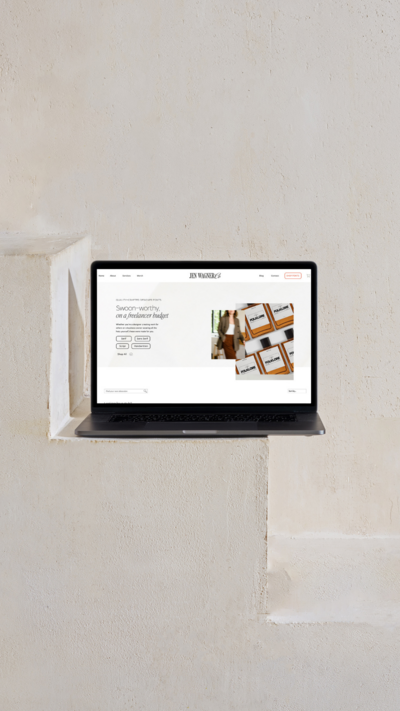
One of my clients, Jen Wagner, runs a shop with 200+ products — she’s a font designer serving both digital and physical products for her community.
When I started working with her, she was on Shopify. The platform worked fine technically, but her conversions weren’t where she wanted them to be.
We moved her from Shopify to Showit + WooCommerce.
Within days of launching, she doubled her conversion rate. And it’s continued to grow since.
So what changed? The products were the same. The prices were the same. But the conversion structure was completely different:
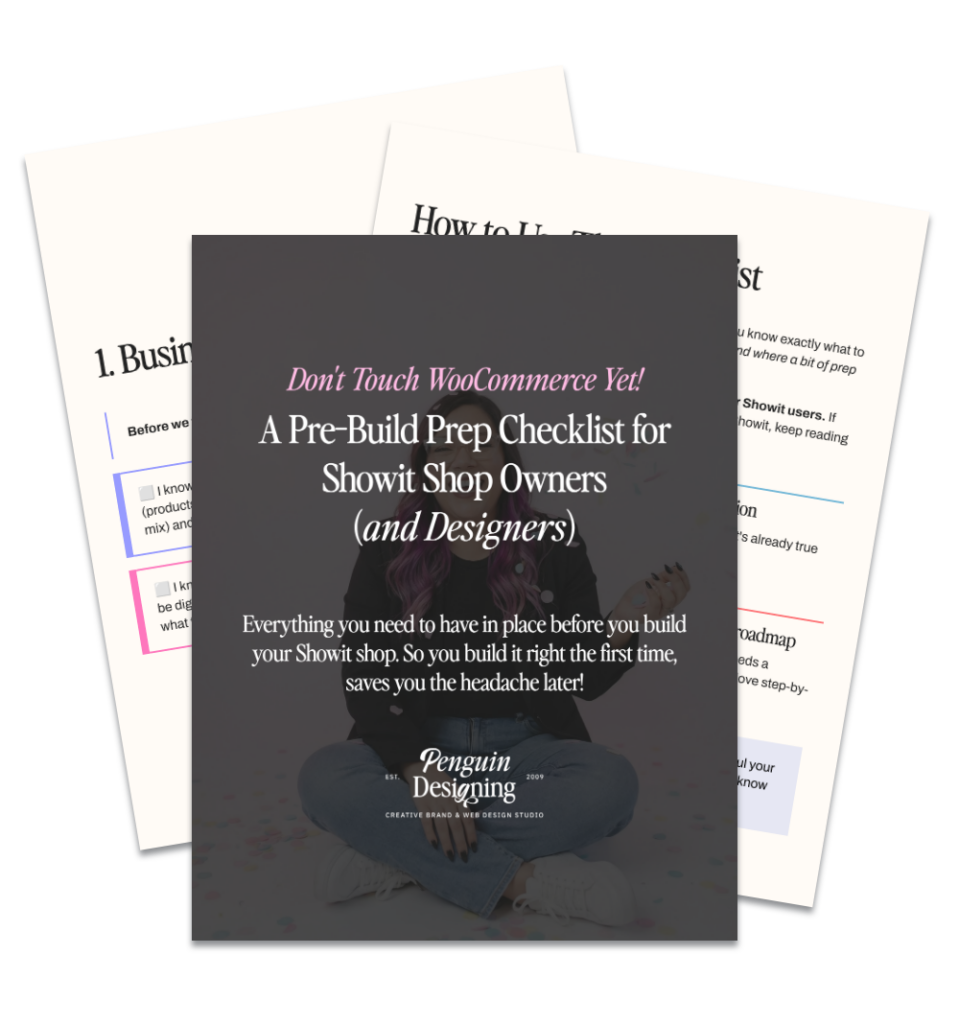
Free download: Don’t Touch WooCommerce Yet!
The pre-build prep checklist for Showit users wanting a Woo shop (or if you’re a designer wanting to set one up!) – so you build it right the first time.
Clearer navigation reduced decision fatigue.
Instead of overwhelming visitors with 200 products at once, we created strategic pathways based on where they were in their photography journey.
Reduced friction in the buying journey.
We simplified the checkout experience, removed unnecessary steps, and made the path from interest to purchase feel natural instead of transactional.
WooCommerce gave us the scalable infrastructure, and paired with our strategy-first set up, it was a winning situation.
The shops that struggle with WooCommerce are usually the ones treating it like a simple plugin instead of building proper infrastructure. The shops that thrive are the ones who understand that user flow and experience matters more than platform.
Shopify Starter + Showit: When It Works — and When It Doesn’t
I know why this combination is tempting.
You’re thinking: “I want Shopify’s checkout with Showit’s design freedom.“
And I get it. And you can do it!
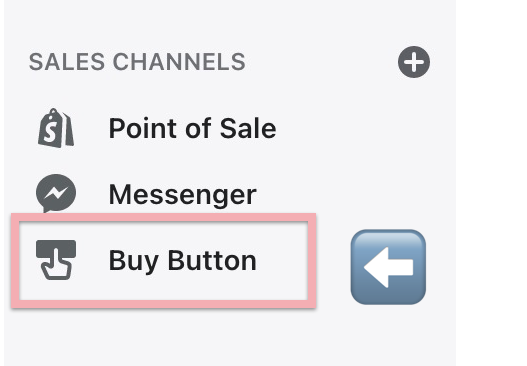
Shopify Starter (their lowest-tier plan) lets you embed buy buttons on any website — including Showit. So in theory, you could have the best of both worlds.
But here’s where I need to be honest with you about when this actually makes sense versus when it creates more problems than it solves.
I recommend Shopify Starter with Showit only when:
Your shop is relatively static (you’re not constantly adding new products or categories)
You have ~10 products or fewer
You have no plans for rapid product growth
You need minimal catalog changes over time
The shop is secondary to your main business (services, coaching, etc.)
In these specific scenarios, Shopify Starter + Showit can work well.
You get Shopify’s reliable checkout, and you maintain design control for the rest of your site.
But once a shop starts growing, Shopify Starter often creates more upkeep than most business owners expect.
Why? Because you’re manually managing product embeds across multiple pages.
Every time you add a new product, you’re updating buy buttons.
Every time you want to change how products display, you’re rebuilding layouts.
There’s no centralized product management on your Showit pages — just individual embeds that need individual attention.
For static, small shops? Totally manageable.
For growing product-based businesses? It becomes tedious fast.
If your shop is going to grow, it’s worth setting up proper infrastructure from the beginning instead of creating a hybrid setup that you’ll outgrow in six months.
This doesn’t mean Shopify Starter is bad. It just means it has a specific use case — and if you’re outside that use case, you’re probably better off with either standalone Shopify or Showit + WooCommerce, depending on your business model.
Why People Think “Showit Can’t Handle E-Commerce” (And Why That’s Not True)
Let me address this head-on because it’s one of the most persistent myths in the Showit community.
“Showit can’t handle e-commerce.” “WooCommerce is too complicated.” “You need to be on Shopify if you’re serious about selling.”
Honestly? It’s just that poor setups ≠ poor platforms.
The shops that struggle with WooCommerce are almost always dealing with one of three issues:
1. They’re treating Woo like a simple plugin instead of infrastructure.
WooCommerce isn’t complicated — but it is unforgiving when strategy is missing.
If you just install it and expect it to work like Shopify out of the box, you’re going to be frustrated.
It needs proper security, proper payment gateway setup, and proper optimization. That’s not complexity — that’s infrastructure.
2. They’re copy-pasting Shopify logic into Showit environments.
Shopify and WooCommerce work differently.
If you’re trying to recreate Shopify’s structure on Showit + Woo, you’re missing the entire point of why you’d choose Showit in the first place. The strength of Showit + Woo is design and structure flexibility — but that requires thinking differently about how products get presented, not just copying what works on Shopify.
3. They didn’t set up conversion structure — they just built a shop.
This is the big one. A lot of “failed” WooCommerce shops aren’t failing because WooCommerce can’t handle them.
They’re failing because the conversion structure was never built. No strategic landing pages. No trust-building before checkout. No navigation strategy.
Just products thrown onto a beautiful Showit site with no thought about buyer psychology or decision flow.
If you approach it tactically (“I need a shop”) instead of strategically (“I need a conversion strategy that makes a shop that is easy for my customers to buy from”), you’re going to struggle.
But when it’s set up with conversion in mind? When you understand buyer psychology, decision fatigue, and trust-building? When you design the pre-purchase experience just as carefully as the checkout flow?
Showit with WooCommerce becomes one of the most powerful tools in your business.
This is why I created WooCommerce Unleashed — because the platform isn’t the problem. The strategic setup is. And once you understand the foundations, everything clicks into place.
A Simple Decision Framework
Okay, let’s bring this all together with a clear decision framework you can actually use.
Choose Shopify if:
Your business is product-forward and conversion happens at the product grid
You don’t need extensive blogging, landing pages, or content infrastructure
You’re selling straightforward physical or digital products that don’t need much context
Design flexibility within Shopify themes is enough for your brand
You want built-in infrastructure without managing additional plugins
Your shop is your primary business (not hybrid with services or education)
Choose Showit + WooCommerce if:
Your brand relies on storytelling, trust, and narrative-led conversion
You sell (or plan to sell) services + products, education, memberships, or digital offers
Conversion happens before the product grid — on landing pages, blog content, or strategic messaging
You need complete design control without learning code
You’re building a hybrid business that needs flexibility as you grow
You want full ownership over your site’s infrastructure (no monthly platform fees per transaction)
Reconsider both if:
You don’t have clarity on your offer positioning (the platform won’t fix that)
You’re overwhelmed by choice and need to simplify first (start with services, add products later)
You’re chasing what competitors are using instead of what your business model needs
You haven’t defined your customer journey (platform choice should support this, not determine it)
The clearer you are, the less energy you spend “figuring it out”
Map your customer journey best offers for only $27.
When you create your very own Customer Journey Offer Tracker following my lead inside Offer Synergy, you’ll easily map your unique customer journey and track your timely, relevant offers that help boost conversion rates and bring more revenue in the door.
You can have the most beautiful Shopify site and still struggle to make sales if your messaging doesn’t build trust.
You can have the most flexible Showit + WooCommerce setup and still see cart abandonment if your checkout experience creates friction.
You can switch platforms three times and still face the same issues if the underlying problems are about positioning, clarity, or buyer psychology.
What really drives conversion, has nothing to do with which platform you choose. It’s about:
Buyer psychology.
Understanding why people hesitate, what creates trust, and how decision fatigue impacts purchasing behavior.
Trust before checkout.
Your customers need to feel confident in you before they hand over their credit card. That confidence gets built (or broken) long before they see the cart.
Messaging gaps.
If your brand messaging doesn’t clearly communicate value, solve a specific problem, or speak to your ideal customer’s actual needs — the platform won’t save you.
Need a hand on this? Read this conversion optimization guide →
Conversion structure.
The path from awareness to purchase needs to feel natural, not forced. This means strategic landing pages, clear navigation, intentional CTAs, and a user experience that reduces friction at every step.
This is where my work lives. Yes, I help clients set up WooCommerce shops. Yes, I design Showit websites. But the real transformation happens when we address the strategy behind the setup.
Because here’s what I’ve seen over and over: platforms don’t fix unclear offers.
If you’re struggling to convert, the first question isn’t “should I switch platforms?” It’s “do my customers clearly understand what I’m selling, why it matters, and why they should buy from me?”
Once you have that clarity, the platform choice becomes so much easier.
And if you’re realizing that your site might be leaking conversions because of strategy gaps (not platform limitations), this is exactly what I help clients fix through site audits and strategic consulting. Send me a note and let’s chat about it.
Let me leave you with this: there is no “best” platform. There’s only best fit.
And best fit is determined by your business model, your conversion structure, and how your customers actually buy from you.
If you’re product-forward with straightforward offers, Shopify might be perfect.
If you’re experience-first with hybrid offers, Showit + WooCommerce might be the better choice.
If you’re somewhere in between, the decision gets more nuanced — and that’s okay.
You’re not wrong for being confused. Platform decisions are legitimately complex when you’re trying to make the strategic choice, not just the popular one.
But here’s what I want you to take away from this: the right setup reduces friction instead of creating it.
If your current platform feels like a constant battle, if you’re working around limitations instead of working within a system that supports you, if you’re spending more time managing your site than growing your business — that’s a sign something needs to shift.
Not necessarily your platform. But maybe your setup, your structure, or your strategy.
Ready to figure out what’s actually holding your site back?
I’d love to help you identify where the gaps are.
Book an audit and we’ll walk through exactly what’s working, what’s not, and what strategic shifts would make the biggest difference for your conversions.
Or, if you’re and DIY person committed to the Showit + WooCommerce path and want to set it up right from the beginning, check out WooCommerce Unleashed. →
Ready to turn your website into a powerhouse lead generator even on a saturated market?
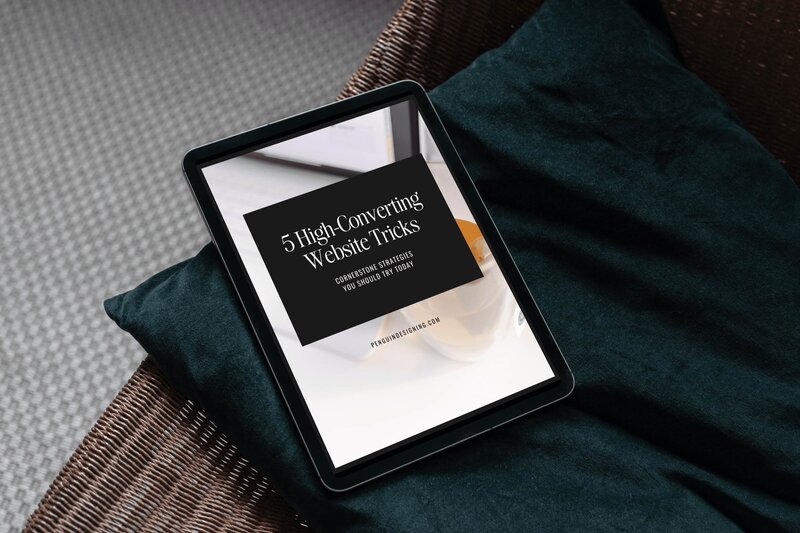
My free guide, "5 High Converting Website Tricks", gives you key strategies to create a website that showcases your brand, attracts your ideal clients, and is ready to convert them into paying customers.
I design strategy-led brands and Showit websites that confidently represent you.
I’m a designer with a magic touch for monetizing websites. I’m also a tea-lover, dog momma, Ravenclaw, INFP and 2w3 (for all you personality-test nerds like me).
I’ve also been called a Showit website expert (been with them since 2013), and a sucker for understanding customer journeys, brand psychology, and consumer and sales psychology. My clients have some pretty cool results after working together, things like doubled shop conversions, booked-out services in weeks, and increased monthly revenue, among other cheer-worthy celebrations.