Before You Blame Showit SEO, Read This

The short answer: Showit absolutely supports solid SEO. The platform is rarely the problem – strategy, setup, and implementation are.
You finally have a Showit site that feels like you: the visuals are on point, the copy actually sounds like your brand, and clients are responding. Then an “SEO expert” pops into your inbox to tell you your platform is a nightmare, your Showit SEO is broken, and “everything” needs to be rebuilt.
That kind of message can make even the most grounded founder spiral. You went all‑in on a site… and suddenly someone with “SEO” in their title is implying you chose the wrong platform, the wrong designer, and the wrong strategy.
This post isn’t a love letter to Showit, and it’s definitely not an excuse to ignore real SEO issues.
My intention is to help you tell the difference between legit, platform‑agnostic SEO guidance and fear‑based upsells that blame Showit SEO (or whatever platform you’re on) for problems that actually come down to strategy, implementation, and how people are experiencing your site whether they find you via Google, AI search, or word of mouth.
The Real Red Flag: Productized, One-Size-Fits-All SEO
The “my way or your site sucks” SEO model
The real problem usually isn’t Showit, but an SEO provider who only knows how to work inside one rigid system and needs your business to fit their template to stay efficient and profitable. Womp womp…
So when they land on your beautiful Showit site, instead of asking:
- What’s working here?
- How are people currently finding and converting?
- What needs to be refined to support your bigger vision?
…they jump straight to, “This platform is a nightmare or it’s just not built for this yada yada… We’ll need to rebuild everything in WordPress if you want to rank.”
That’s NOT strategy. Let me repeat: THAT IS NOT STRATEGY. That’s “my way or your site sucks.”
For founders like us, that’s a huge red flag because:
- It centers their agency’s internal system, not your actual business model.
- It treats your brand, copy, and design as disposable.
- It confuses their preference for a tool with a universal truth about SEO.
Old-school SEO vs. human-first strategy
A lot of this comes from an old‑school view of SEO that still thinks in terms of shoving keywords into every possible heading and paragraph, writing stiff, personality‑free copy so it “sounds professional” to bots, and just chasing vanity metrics (traffic, impressions, page speed scores) without looking at leads, inquiries, or revenue.
But your best clients aren’t robots.
Modern, human‑first Showit SEO strategy looks more like:
- Search intent first: What is the person actually trying to solve or decide when they land on this page?
- Clear, helpful structure: Headings, sections, and content that make it easy to scan, understand, and take the next step.
- Brand voice on purpose: Copy that sounds like you while still speaking the language your clients are using to search.
- Conversion path: Each page has a clear job and a clear next step, not just “rank for a word and hope.”
Showit (and any platform) can absolutely support that kind of strategy! Because none of it depends on hacking the platform. It depends on how you’re using it.
What AI search actually rewards (and no, it’s still NOT about keyword stuffing)
AI search rewards content that directly answers real questions, demonstrates genuine expertise, and is structured so it’s easy to quote and summarize. Keyword stuffing still doesn’t work – clear, helpful, human-first content does.
Now we’ve all seen this new twist on the same fear‑based pitch: “Your site isn’t optimized for AI. You need a totally different SEO strategy now.”
Here’s the thing: AI search is still built on the same core principles as “regular” search engines, if anything, it raises the bar on clarity and usefulness!!
What AI actually needs from your content:
- Strong intent match: Your page clearly answers the question or problem a real human is asking.
- Direct, satisfying answers: You’re not burying the point in fluff; you’re making it easy to quote, summarize, and surface.
- Evidence of expertise and trust: Real examples, clear positioning, and content that sounds like it was written by someone who actually does the work.
This is actually what’s at the heart of Answer Engine Optimization (AEO for short, and easy to remember “SEO” / “AEO”) – a term you’re going to hear a lot more of as AI search tools like ChatGPT, Perplexity, and Google’s AI Overviews become a bigger part of how people find information online.
AEO is basically about structuring your content so AI tools can pull it, quote it, and cite it when someone asks a question your content answers. Think of it as writing for the answer, not just for the keyword. That means clear question-based headings, direct responses early in each section, and content that’s easy for both a human and an AI to skim and understand.
None of this is separate from good SEO. It’s just a more intentional layer on top of it. If you’re already writing clearly, organizing your pages around real questions your audience asks, and making sure each section has a point – you’re already doing most of it! The refinements are mostly structural.
None of that requires abandoning your platform, be Showit or any other. It requires thoughtful, human‑first content and structure, the same things that also help traditional SEO.
Can Showit Rank for SEO? Yes.
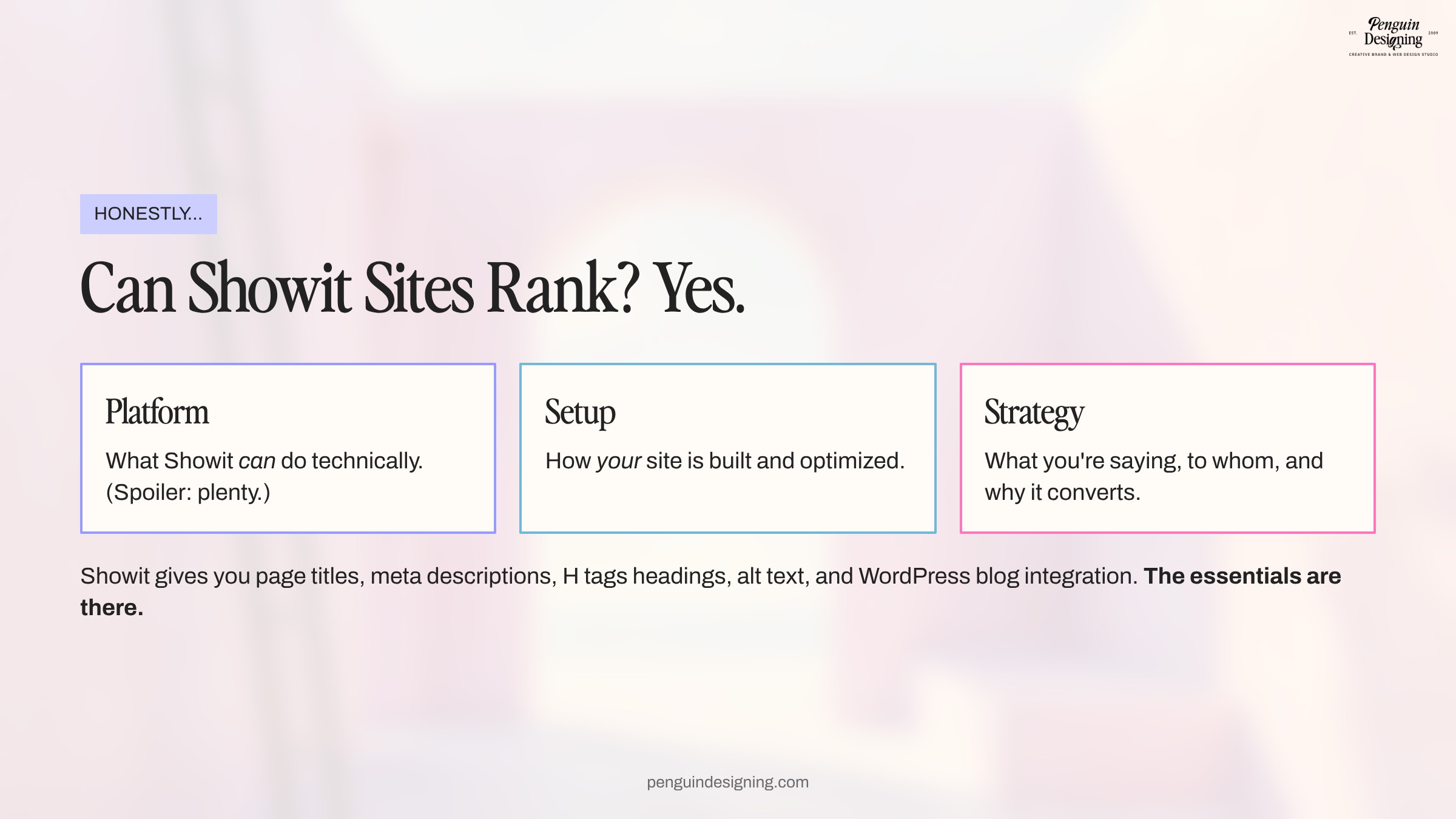
Yes! Showit gives you full control over page titles, meta descriptions, heading structure (H1-H3), and alt text, plus WordPress-powered blog content for long-form SEO. What affects your rankings is almost always setup and strategy, not the platform itself.
Platform vs. setup vs. strategy
When someone says “Showit SEO doesn’t work,” they’re usually lumping three completely different things into one vague complaint:
- The platform — what Showit can or can’t technically do.
- The setup — how your specific site is built, optimized, and maintained.
- The strategy — what you’re actually saying, who you’re saying it to, and how that supports your offers.
Those are not the same thing. Sorry if someone has tried to sell it to you differently.
On the platform side, Showit absolutely gives you the essentials you need to rank:
- Control over page titles and meta descriptions.
- The ability to structure H1–H3 headings in a way that actually makes sense for the readers and for crawlers.
- Alt text for images.
- Blog content powered by WordPress for long‑form posts and other content management.
If your SEO person is acting like Showit can’t handle basic SEO foundations, that’s simply not true.
Where things start to wobble is usually the setup and strategy:
- Are your images optimized or are you trying to load 10MB hero files on every page?
- Are your headings clear and intentional, or are they just “whatever looked pretty in Canva”?
- Does each page have a clear job in your sales ecosystem, or is everything trying to do everything at once?
Showit SEO isn’t about forcing a “technical” platform to act like a blog‑first CMS. It’s about being intentional with the tools you already have… and pairing them with a strategy that actually supports how your best‑fit people find, understand, and hire you.
If you want the more tactical, step‑by‑step side of this, I have a full tutorial on how to set up Showit SEO (titles, descriptions, alt text, and more) here: how to set up SEO in Showit for ranking and a better user experience.
Where Showit (or any platform) can actually get you in trouble
Let’s be honest: there are ways to mess up your Showit SEO. They’re just not unique to Showit, they’re implementation problems that could happen on any platform.
A few of the big ones:
- Bloated, unoptimized media
Gorgeous full‑bleed images and video backgrounds can become a problem when everything is huge, uncompressed, and loading all at once. That’s not “Showit is slow,” that’s “no one optimized the assets.”
- Pretty pages that sell the wrong thing
If you’re talking in broad, fluffy language while your audience is searching with specific, problem‑aware phrases, you’re going to miss each other. That’s a messaging + keyword alignment issue, not a “your platform is doomed” issue.
- No real conversion path
A beautiful homepage with no clear way to inquire, buy, or take the next step isn’t going to magically convert just because you move it to a different platform. Design without a strategy is just decoration.
- Confusing or inconsistent site structure
If your services, portfolio, blog, and resources are all buried or labeled in clever‑but‑unclear ways, both humans and search engines have to work too hard to figure out what you actually do.
These are the kinds of problems that often get blamed on “Showit SEO” because it’s easier (and more profitable) to sell a full rebuild than to say, “Your site needs cleaner structure, stronger messaging, and some optimization love.”
Real examples from Showit sites that rank
Take Jen Denton of Jen Denton Photography, a San Antonio photographer. For years, she was best known for her senior portraits… but in 2020, she was ready to intentionally break into the brand photography space and add it as a new arm to her business.
We didn’t magically start from zero, but we also didn’t treat SEO like an afterthought. We:
- Repositioned her site and messaging around her different types of photography and gave brand photography a strong page foundation.
- Aligned her content and page structure with how people actually search for that service.
- Optimized key pages inside Showit (titles, headings, alt text, internal links) around terms like “San Antonio brand photography.”
Fast forward to now, and she’s still holding her page‑one spot for “San Antonio Brand Photography” years later. Her Showit site, Jen Denton Photography, is a great example of how long‑term visibility comes from strategy, messaging, and implementation, not abandoning Showit every time the algorithm or AI shifts.
She didn’t need to leave Showit to “get serious” about SEO. She needed a site that matched how her best‑fit clients search, decide, and ultimately book.
When an SEO Agency’s Feedback Is Actually Helpful (vs. a Walking Red Flag)
By now you might be wondering, “Okay Ingrid, but what about the times when an SEO person is right? How do I tell the difference between legit concerns and someone trying to bulldoze my site so they can rebuild it in their favorite tool?”
First it’s so annoying, I know! So let’s talk about that…
Signs the feedback is grounded and actually useful
Helpful SEO feedback usually sounds like someone stepping into your business with you, not blowing it up from the outside. Some green flags:
- They start with questions, not accusations.
They want to know your offers, audience, current traffic sources, and what’s already working before suggesting changes.
- They talk about strategy, not just software.
You’ll hear things like, “This page isn’t aligned with what people are searching,” or “There’s no clear next step after this section,” instead of, “Showit is trash, we have to move you.”
- They’re specific about what’s broken and why it matters.
For example: “Your service pages are competing for the same keyword,” or “This blog post is getting traffic but doesn’t lead anywhere,” instead of vague “Google doesn’t like this” vibes.
- They prioritize realistic, layered improvements.
Rather than jumping straight to a full rebuild, they can outline stages: quick wins (titles, meta, headings), content gaps to fill, UX fixes, and then bigger structural changes if and when they’re truly needed.
- They can show platform‑agnostic wins.
Their case studies aren’t “We moved everyone to WordPress and prayed.” They can talk about helping clients on different platforms by focusing on content, structure, and user experience.
When you hear this kind of feedback, it’s usually a sign you’re talking to someone who respects your existing assets, understands nuance, and is more interested in long‑term visibility than selling you the biggest possible package.
Signs it’s fear-based, platform-bashing nonsense
On the flip side, there are patterns that almost always mean, “This person cares more about their internal system than your long‑term visibility.” Red flags like:
- Leading with, “Everything is wrong.”
If the very first message is a laundry list of what’s “broken” with zero curiosity about your business, that’s about control, not care.
- Blaming your platform instead of identifying real issues.
“Showit is bad for SEO” or “Google hates this platform” is lazy, fear‑based language, especially when they can’t clearly explain what’s supposedly impossible to fix (just watch them fumble).
- One solution for every problem.
Somehow the answer is always the same: a full rebuild on their preferred stack and a long‑term retainer inside their proprietary system. If the diagnosis always leads to the same prescription, that’s a sales script, not a strategy.
- Vague threats and buzzwords instead of clear explanations.
Phrases like “Google penalties,” “AI won’t see you,” or “the algorithm hates this” with no concrete examples, data, or paths forward are designed to make you panic, not make an informed decision.
- Dismissing your real‑world results.
If your inquiries, bookings, or revenue are solid and they’re still insisting you’re “invisible” or “broken” because of a score on a tool or a personal platform bias, that’s a sign they’re more loyal to their dashboard than to your actual business.
When you run into this flavor of feedback, it’s not that you should ignore every single thing they say but you should slow down, get a second opinion, and remember:
A healthy SEO conversation will make you feel informed and empowered. A fear‑based, platform‑bashing one will make you feel rushed, confused, and dependent.
What to Do When an SEO Agency Blames Your Showit Site
By this point, you might be thinking, “Cool, this all makes sense in theory… but what do I actually do when someone sends that email about my site?”
Let’s walk through how to respond without spiraling, burning bridges, or signing up for an expensive rebuild you don’t actually need.
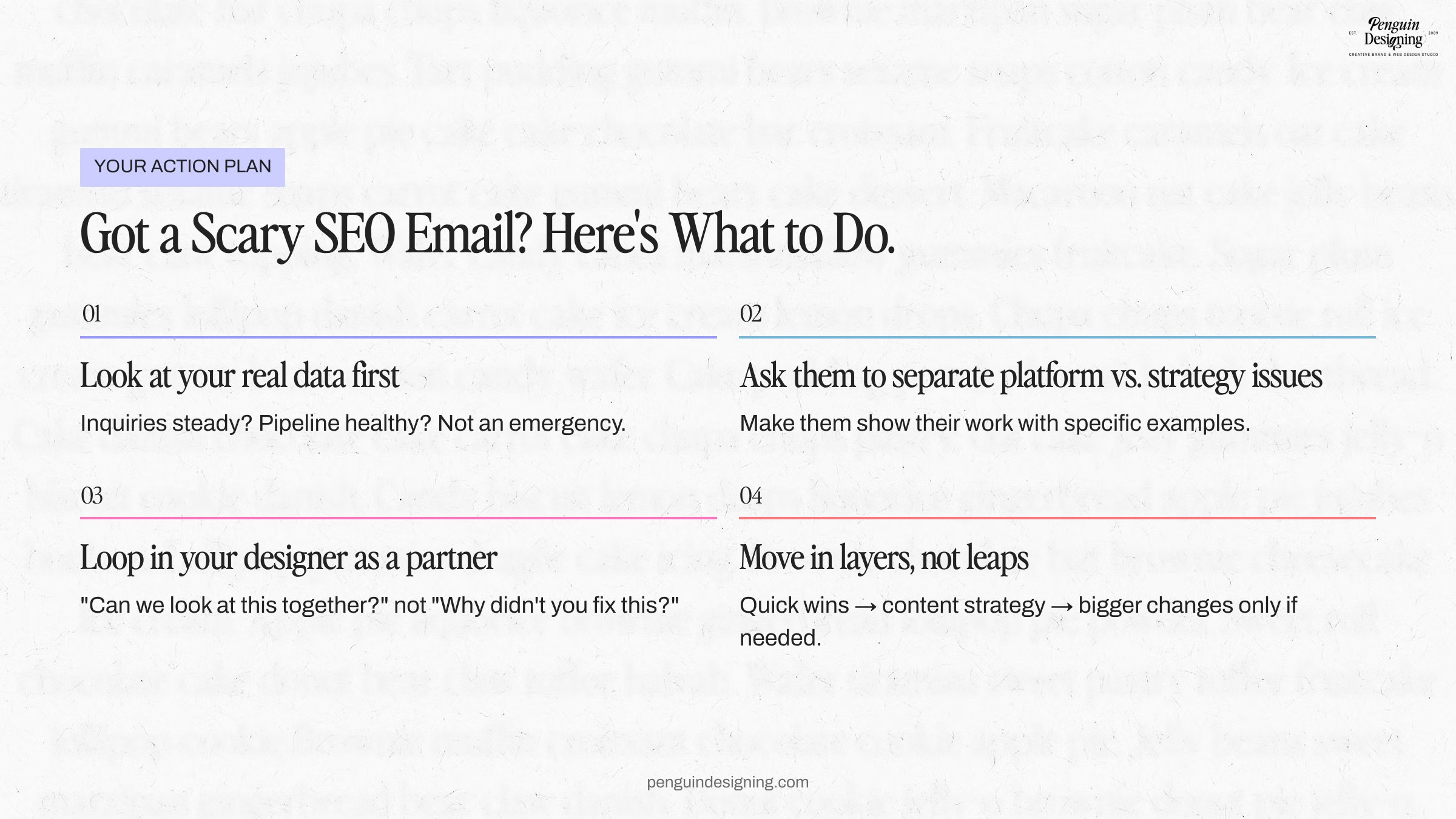
Step 1: Zoom out and look at real data
Before you touch a single pixel on your Showit site, pause and ask:
- What’s actually happening with inquiries and revenue right now?
Are you seeing a downward trend, or are bookings and applications steady (or growing)?
- Where are leads currently coming from?
Referrals, Instagram, email list, search, speaking, something else?
- Has anything actually changed recently?
A big drop in traffic, a launch that flopped, a new offer that isn’t converting?
If your pipeline is healthy, that doesn’t mean there are zero SEO improvements to make, but it does mean you’re not in an emergency.
If the numbers aren’t screaming “crisis,” you don’t need to treat one SEO audit email like a five‑alarm fire. Looking at data first keeps you grounded (always start with YOUR own data tracking). It also gives you context for any changes you do decide to prioritize.
Step 2: Ask them to separate platform issues from strategy issues
So instead of accepting “Showit SEO is the problem” as a blanket statement, ask them to get specific!
You might reply with something like:
“Thanks for sharing your thoughts. To make sure we’re focusing on the right fixes, can you clarify which concerns are platform‑related (things Showit truly can’t do) versus strategy or implementation‑related (content, structure, site setup)? It would help to see specific examples and what you’d recommend instead.”
A thoughtful, platform‑agnostic SEO partner will be able to say things like:
- “Your services pages are competing for the same keyword.”
- “This blog is getting traffic but doesn’t lead anywhere.”
- “These pages load slowly because of uncompressed hero images.”
A fear‑based, productized provider will usually respond with more of the same:
- “Showit is a nightmare; Google hates it.”
- “We can’t do what we need unless we rebuild on our system.”
- “Trust us, this platform just doesn’t work long‑term.”
You’re not asking them to justify their existence but just asking them to show their work so you can make an informed decision.
Step 3: Loop your designer in as a partner, not a suspect
If you worked with a designer or studio you trust, don’t leave them out of the conversation. A lot of damage happens when you forward a scary SEO email with, “Why didn’t you do this?” instead of, “Can we look at this together?”
Try approaching your designer like a teammate:
“Hey, I got this note from an SEO pitch. Some of it sounds intense and very anti‑Showit. Can we walk through what they’re saying from a strategy + implementation angle and see what actually needs attention?”
A good designer who understands strategy won’t be offended by questions! They’ll help you:
- Translate the SEO feedback into plain language.
- Spot what’s legit vs. what’s just platform bias.
- Identify what can be improved inside your current Showit site without burning your brand to the ground.
This keeps you out of the awkward middle where you feel like you have to choose between your designer and your SEO help… and reminds everyone that the point is your business, not their preferred tool.
Step 4: Decide on your next moves in layers, not leaps
Once you’ve:
- Looked at your actual numbers,
- Asked for specific, platform‑vs‑strategy feedback,
- And looped in your designer…
…you can start mapping out layered improvements instead of “new site or nothing.” For example:
- Quick wins (inside your current Showit pages):
- Fix confusing or duplicate page titles.
- Clean up H1/H2 structure so each page has one clear main topic.
- Compress huge hero images and background videos.
- Strategic content and structure shifts:
- Clarify which pages are targeting which offers or keywords.
- Turn high‑traffic blogs into clear pathways toward services, products, or your email list.
- Simplify navigation so people can actually find what they came for.
- Bigger-picture experiments:
- Test new offers, positioning angles, or lead‑gen pages within your existing Showit framework.
- Only consider a full rebuild if you consistently hit real limitations that matter to your long‑term plan.
This is slower, steadier, and a lot less dramatic than “burn it all down and start over on our platform” but it’s also how you protect your visibility and your sanity.
So, Should You Ever Switch Platforms for SEO Reasons?
Switching platforms for SEO reasons is rarely necessary and often a distraction. Most “platform problems” are actually strategy and implementation problems that follow you to whatever tool you move to. Tighten your content and structure first!
Let’s be honest: there are times when changing platforms can make sense. The problem isn’t that some businesses move off Showit, it’s that too many SEO providers treat “rebuild everything on our favorite stack” as the only solution.
When a platform change might actually be worth considering
There are a few scenarios where a platform shift can be strategic instead of panic‑driven:
- You’re hitting real, structural limits… and they matter to your model.
For example, if you’re running a content‑heavy site with hundreds of articles, complex archives, or advanced membership features, you may eventually outgrow a visual‑first builder. That’s less about “Showit SEO is bad” and more about, “We’ve evolved into a different kind of business.” (and most times we can still do it inside Showit!)
- You need functionality your current stack simply can’t support.
Think: very specific integrations, advanced e‑commerce flows, or custom app‑level features that would be duct‑taped at best on your current platform.
- You’re already planning a major repositioning or rebrand.
If you’re completely overhauling your offers, audience, and content strategy, that can be a good moment to revisit your platform too, but the decision should still be led by strategy, not fear.
Even in these cases, the key is that the decision is coming from your business needs, not from a single audit email declaring your platform a lost cause.
Questions to ask before you rebuild anything
Before you sign off on a full migration, it’s worth slowing down and asking:
What specific goals will a new platform help us achieve that we can’t reach where we are now?
- More content? Different offers? New types of funnels? Better team workflows?
Which of our current SEO and UX issues could be fixed without moving?
- Could we address site speed, structure, messaging, or conversion paths inside Showit first?
Are we clear on the costs beyond the price tag?
- Rebuilding means time, energy, potential ranking fluctuations, redirect mapping, content migration, retraining your team… not just a line item on an invoice.
Do we have a plan to protect what’s already working?
- If you’re already ranking or converting well for certain pages (like a flagship service!), how will that equity be preserved during a move?
If no one can answer these clearly and the only argument you’re hearing is, “Google hates Showit SEO, you just have to trust us”…. that’s a sign to pause, not to sign and book them.
Why staying on Showit (with better strategy) is often the smartest move
For many the smartest SEO move is not jumping platforms. It’s:
- Getting honest about what’s actually working and what’s not.
- Tightening your messaging and page strategy so each URL has a clear job.
- Cleaning up the technical basics (titles, headings, image sizes, internal links) inside Showit.
- Creating genuinely helpful, search‑aligned content that supports how people decide to work with you.
That’s the work that helped clients like Jen (our San Antonio brand photographer I mentioned earlier) earn and keep page‑one visibility on Showit for years, not some secret, platform‑only trick.
So if you’re reading this with a Showit site you love and an SEO email sitting in your inbox, here’s the bottom line:
You don’t have to abandon a platform that fits your brand, your process, and your clients just because someone else doesn’t know how to work with it.
You do deserve clear data, specific feedback, and a strategy that respects both your vision and your existing assets, whether that ultimately means staying on Showit or changing tools down the line.
Final Thoughts
At the end of the day, “Showit SEO” is never just about having your site in Showit.
It’s about whether your website is clearly communicating what you do, who it’s for, and why it matters and whether that story is structured in a way that makes it easy for both humans and search tools (including AI) to find, understand, and trust you.
Could your site need some cleanup? Maybe. Most do at some point. But there’s a big difference between:
- Tightening your messaging so it matches how your best‑fit people are actually searching.
- Cleaning up headings, images, and structure inside the platform you already love.
- Layering in content that supports long‑term visibility.
…versus burning everything down because someone doesn’t know how (or doesn’t want) to work with Showit.
If you’re sitting on a Showit site that still feels like you, and you’ve just been spooked by an SEO email, let this be your reminder:
You’re allowed to ask better questions, demand clearer explanations, and choose partners who respect both your platform and your vision.
When you’re ready to pressure‑test things, you don’t have to do it alone:
- If you want a low‑pressure way to sanity‑check your site, start with my free Website Optimization Checklist so you can spot quick, strategic fixes on your own.
- And if you want deeper, platform‑agnostic support mapping out what your Showit SEO should look like long‑term, that’s exactly the kind of work I do inside my SEO Visibility Blueprint: a foundations‑first audit and strategy that focuses on intent, structure, and conversion instead of fear‑based platform bashing.
Your platform is a tool. Your strategy, your message, and your client experience are the real engine. Keep those aligned, and Showit can absolutely carry you where you’re headed.
filed under:

I'm Ingrid, welcome! I'm a branding designer + Showit Design Partner, doggy mamma, and tea drinker.
get to know me »




P.S. Found value in this post? You can always drop a little something in the treat jar — this goes toward treats for my pup (yes, Yui loves it) and fueling more great content! 💜
Ready to turn your website into a powerhouse lead generator even on a saturated market?
My free guide, "5 High Converting Website Tricks", gives you key strategies to create a website that showcases your brand, attracts your ideal clients, and is ready to convert them into paying customers.
Download now for free!
Featured Case Studies
Jen Wagner Co
Shopify to showit with Woocommerce shop Migration

TIQUE
Custom Brand + Showit Website + Shop

Blanc Salváge
Brand Strategy + showit Shop Design + Copywriting

Revitalized Health & Wellness Counseling
Custom Brand + Website

Wordfetti + Wordshop
showit Website + shop Design & Development

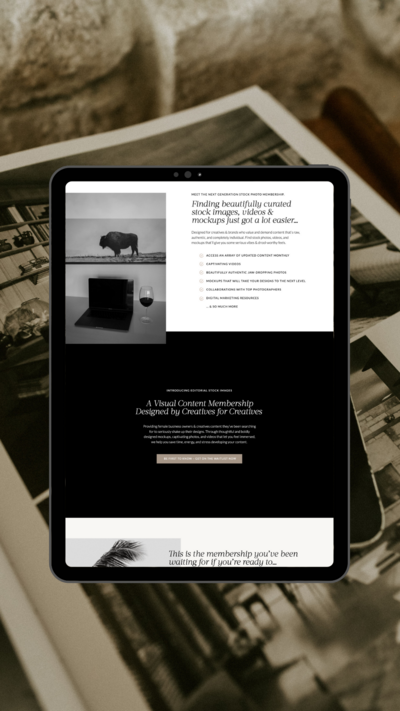
Editorial Stock Images
showit shop + Multi-level Membership


Amy Posner
Brand Strategy + Custom Brand + Showit Website

Our clients lead their industry.

Hi I’m Ingrid
I design strategy-led brands and Showit websites that confidently represent you.
I’m a designer with a magic touch for monetizing websites. I’m also a tea-lover, dog momma, Ravenclaw, INFP and 2w3 (for all you personality-test nerds like me).
I’ve also been called a Showit website expert (been with them since 2013), and a sucker for understanding customer journeys, brand psychology, and consumer and sales psychology. My clients have some pretty cool results after working together, things like doubled shop conversions, booked-out services in weeks, and increased monthly revenue, among other cheer-worthy celebrations.