Digital Product Buyer Psychology: What Makes Someone Click Buy

Over half of all digital product purchases are driven by personal recommendations. AKA: referrals.
If you’ve been pouring energy into tweaking your funnel, stressing about your launch sequence, or wondering why your offer isn’t converting the way you expected – the answer probably has less to do with your tactics and more to do with whether your buyers actually trust you yet.
Digital product buyer psychology is actually pretty predictable once you know what you’re looking at. The reasons people say yes (or close the tab without a second thought) follow real, repeatable patterns. And when you understand those patterns, you stop guessing and start designing your messaging around how people actually decide.
What actually drives digital product purchases?
Digital product purchases are primarily driven by trust and social proof – with 54.6% of buyers citing personal recommendations as their #1 purchase motivator, making referrals more influential than ads, discounts, or promotional content. (source)
This is the stat worth sitting with… More than half of your potential buyers are looking for someone they trust to say “I used this, it’s worth it.” Not a beautiful new social graphic or a flash sale. A real person vouching for the result.
What this means practically: your best marketing asset isn’t your ad budget (there, I said it!). It’s the experience your current buyers are having – and whether that experience is generating the kind of word-of-mouth that does the selling for you.
It also means cold traffic and warm traffic need completely different things from you.
Cold audiences need credibility signals before they’ll take you seriously. Warm audiences (people already in your world, already consuming your content, already nodding along) need a clear, confident offer with strong proof.
The mistake most digital product sellers make is using warm-audience messaging for cold traffic – and wondering why the conversion rate tanks.
Why trust and social proof matter more than discounts for digital products
Your highest-value buyers are relationship shoppers. Full stop.
I know that’s not what every marketing course will tell you. Discounts generate volume – that part is true. But the buyers who find you through a sale, buy because of a coupon, and move on? They’re not your people. They’re not the ones leaving glowing testimonials, referring their peers, or ascending into your higher-ticket offers.
The buyers worth building for are the ones who came in because they trusted you. And trust gets built through transparency, consistency, and proof – not price cuts.
One of the clearest examples of this I’ve seen in my own client work: after a full brand and website overhaul for TIQUE, built specifically to match where their business was growing, they came back to report a 52% increase in sales compared to the previous year’s Black Friday – and made back their investment 6x over in a single sale. More than the numbers, though? Their operations manager barely had to lift a finger. The tech worked. The experience worked. The trust was already there before the sale even started.
That’s what happens when the whole customer experience is designed with intention – not just the offer itself.
Here’s what actually moves people from “maybe” to yes:
- Testimonials with specific outcomes (not just “she’s amazing!” – but “here’s what changed after I worked with her”)
- Total cost transparency – no surprise fees, no vague pricing, no “DM me for details”
- Consistent brand presence across every touchpoint, so the experience feels the same whether someone finds you on Pinterest, reads your blog, or lands on your sales page for the first time
- Education-led content that demonstrates you actually know what you’re talking about before you ask anyone to buy
That last one especially. When people can see your thinking before they hand over their credit card, the purchase feels less like a risk and more like a logical next step.
The 5-stage decision process your digital product buyer is actually going through
Every digital product buyer moves through five stages: Awareness, Interest, Evaluation, Purchase, and Post-Purchase Reflection.
Most sellers only optimize for stage four. That’s a BIG problem.
Here’s how my PDP Experience Loop™ maps to this:
Pre (Awareness + Interest): This is where your content, your visibility, and your credibility signals do the heavy lifting. Your buyer is figuring out if you’re the right person to learn from or buy from. They’re watching how you show up, what you teach for free, and whether your vibe matches theirs. Your customer journey mapping process is what determines whether this stage actually leads somewhere – or just generates traffic that bounces.
During (Evaluation + Purchase): This is the stage most people actually think about. But here’s what’s worth knowing – by the time someone lands on your sales page, the evaluation stage is often already underway. They’ve Googled you, they’ve read your reviews, they’ve most likely already watched your free content. The sales page doesn’t start the conversation, it closes it! Which means if your trust-building happened before this moment, conversion gets a lot easier. If it didn’t, no amount of sales page optimization is going to fix that.
Post (Post-Purchase Reflection): This is the most underrated stage of all, and honestly, this is where the referral loop either gets built or gets broken. Your buyer just made a decision. Dopamine is flowing. They’re excited (and maybe a little nervous). What happens next: your onboarding, your thank-you page, your first few touchpoints… determines whether they become a loyal repeat customer who tells everyone, or someone who quietly regrets the purchase and never comes back.
The brands that win long-term are the ones thinking about all five stages, not just the checkout button.
If you want to go deeper on how journey mapping connects to this, the persona vs. journey mapping Inspired Brew podcast episode is worth a listen!
How identity drives purchase decisions
People don’t buy your digital product. They buy the version of themselves they believe your product will help them become.
I get really excited when I get to nerd out on this, because it’s the piece that most offer messaging completely skips over – and it’s the piece that actually moves people.
Think about Apple’s “Shot on iPhone” campaign, or the Mac ads featuring artists and musicians. The product features are almost beside the point. What Apple is really selling is: if you’re a creative, a maker, a person who cares about doing things with intention – this is the tool that belongs in your life. The buyer isn’t just purchasing a laptop. They’re affirming something about who they are.
Your digital product needs to do the same thing!
Your offer copy probably already covers what someone gets (the modules, the frameworks, the deliverables) and what they’ll be able to do after (the transformation). But does it speak to who they’re becoming? Does it make them feel like buying this is an act of investing in the version of themselves they’re working toward?
That’s the identity layer of it all and it’s the difference between copy that informs and copy that converts.
A quick audit you can do: read your offer page and ask yourself – does this sound like I’m describing a product, or does this sound like I understand exactly who my buyer is trying to become? If the answer is mostly the former, that’s your gap!
What I wish I knew before launching my first online offer gets into some of this from a more personal angle – worth reading if you’re earlier in your digital product journey.
What this means for your offer positioning (the practical part)
Okay, let’s bring this together into something you can actually use.
Here are three things worth auditing in your current digital product messaging:
1. Are your trust signals visible before someone reaches your sales page?
Your blog, your social content, your emails, your podcast episodes – all of it is either building trust or it isn’t. If someone could find your offer page without ever encountering proof that you know what you’re doing, that’s a gap. The credibility needs to show up quite earlier in the journey, not just at the checkout moment.
2. Does your copy speak to identity and aspiration, not just deliverables?
Features and outcomes are table stakes. The identity layer is what creates emotional resonance. “You’ll get 8 modules and a workbook” is a feature. “You’ll finally have the strategic foundation your brand has been missing – and you’ll be able to see it” is closer to an aspiration. The second one makes your buyer feel something. That’s the goal with any offer!
3. Is your post-purchase experience building the referral loop?
Remember: 54.6% of digital product purchases come from recommendations. Those recommendations have to come from somewhere. They come from buyers who had a remarkable experience after the purchase – not just during it. If your post-purchase sequence, your onboarding, and your thank-you page are an afterthought, you’re leaving your best marketing channel completely untapped.
This is essentially what I call the PDP Experience Loop™ in action. Pre, During, Post. All three stages designed with intention, all three stages working together. When it’s working, the ecosystem sells itself.
Here’s what the brands that convert all have in common
Buyer psychology for digital products is predictable, the same patterns show up again and again: trust over tactics, identity over features, post-purchase experience as the real conversion catalyst.
The good news is that once you understand how your buyers are actually deciding, you can design your messaging – and your whole offer experience – to meet them there.
If you want to start with a strategic audit of your current brand and offer messaging, the Spellbinding Brand Blueprint is exactly that. It walks you through analyzing whether your brand is actually built to convert – covering visual identity, messaging, and the strategic foundation underneath all of it. Think of this as an entry-level investment, high-level thinking.
And if you’re an established business owner who’d rather have a strategist look at the whole picture with you – that’s what my done-for-you brand strategy and website work is built for. You can reach out here and we can talk about what that looks like.
Either way – you’ve got this!! The strategy exists, it’s just a matter of applying it.
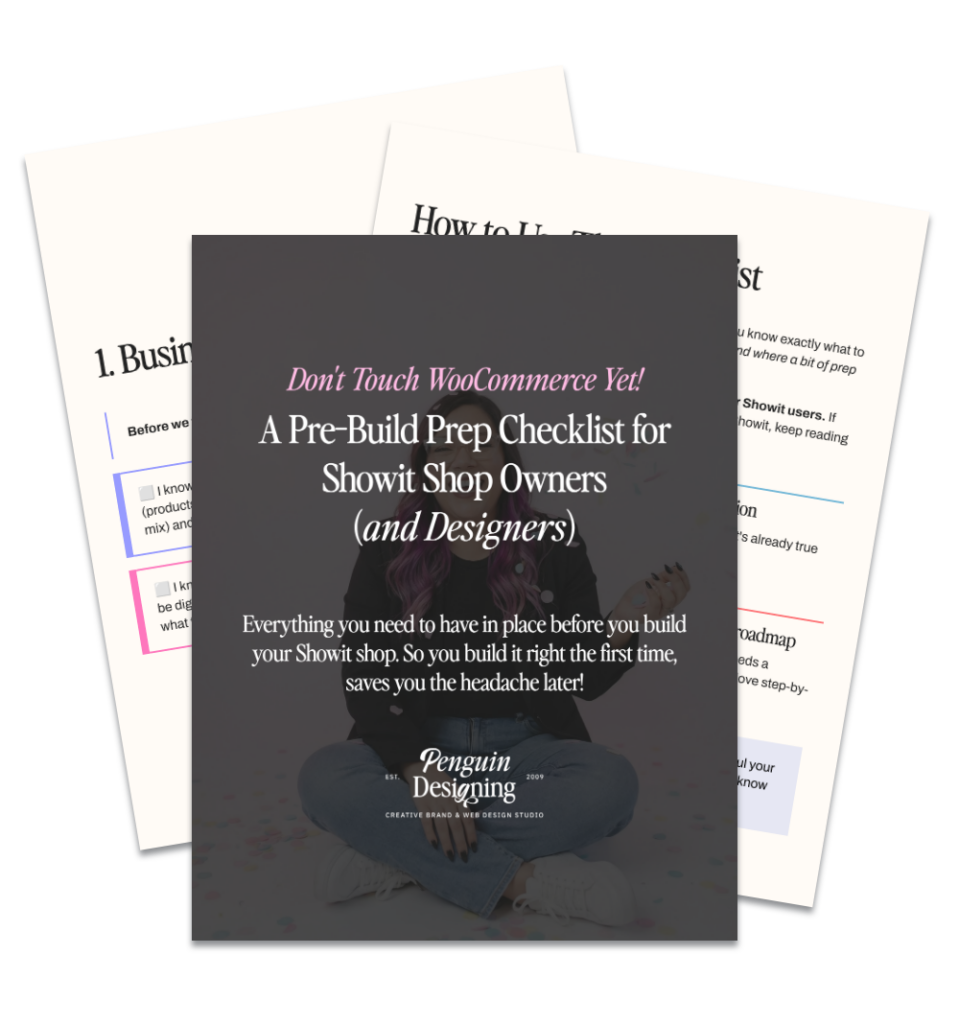
Free download: Don’t Touch WooCommerce Yet!
The pre-build prep checklist for Showit users wanting a Woo shop (or if you’re a designer wanting to set one up!) – so you build it right the first time.
filed under:

I'm Ingrid, welcome! I'm a branding designer + Showit Design Partner, doggy mamma, and tea drinker.
get to know me »




P.S. Found value in this post? You can always drop a little something in the treat jar — this goes toward treats for my pup (yes, Yui loves it) and fueling more great content! 💜
Ready to turn your website into a powerhouse lead generator even on a saturated market?
My free guide, "5 High Converting Website Tricks", gives you key strategies to create a website that showcases your brand, attracts your ideal clients, and is ready to convert them into paying customers.
Download now for free!
Featured Case Studies
Jen Wagner Co
Shopify to showit with Woocommerce shop Migration
TIQUE
Custom Brand + Showit Website + Shop

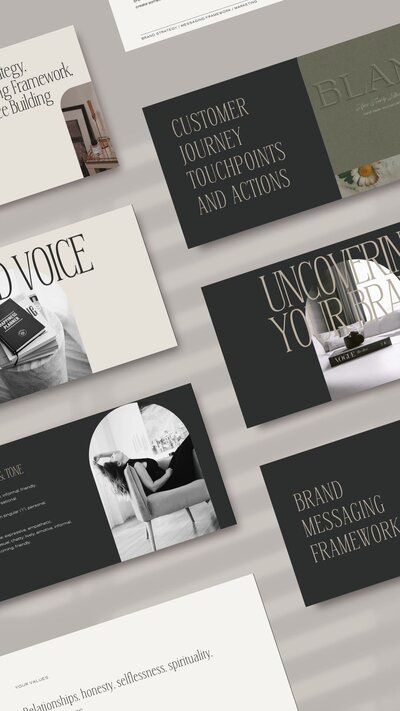
Blanc Salváge
Brand Strategy + showit Shop Design + Copywriting
Revitalized Health & Wellness Counseling
Custom Brand + Website

Wordfetti + Wordshop
showit Website + shop Design & Development

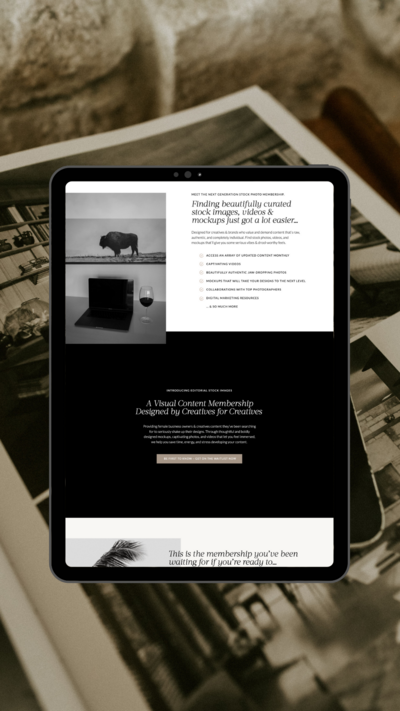
Editorial Stock Images
showit shop + Multi-level Membership


Amy Posner
Brand Strategy + Custom Brand + Showit Website

Our clients lead their industry.

Hi I’m Ingrid
I design strategy-led brands and Showit websites that confidently represent you.
I’m a designer with a magic touch for monetizing websites. I’m also a tea-lover, dog momma, Ravenclaw, INFP and 2w3 (for all you personality-test nerds like me).
I’ve also been called a Showit website expert (been with them since 2013), and a sucker for understanding customer journeys, brand psychology, and consumer and sales psychology. My clients have some pretty cool results after working together, things like doubled shop conversions, booked-out services in weeks, and increased monthly revenue, among other cheer-worthy celebrations.