Okay, I need to confess something that might make me sound like a total stalker… 🫣
When I’m developing a customer journey mapping process for a client, I get really into my detective mode. Borderline creepy levels of research.
But that “stalking”? It’s what turns a good website into a conversion machine!
So let me walk you through my actual customer journey mapping process (and yes, it’s a little intense):
Step 1: The current reality audit
First, I dive deep into what’s happening right now in their business.
I’m looking at their analytics, their current sales process, their website flow, even their email sequences.
Ok nice, but I can’t stop there. Nope! I want to understand their audience’s actual behavior, not just what the business owner thinks is happening.
This is where most customer behavior analysis goes wrong: businesses assume they know their customer journey without actually mapping what’s really happening.
Step 2: The voice of customer investigation (aka the creepy part)
This is where I go full digital detective for customer insights.
I’m reading:
✓ Comments on their social media posts (and I do it from my regular biz IG) ✓ Reviews they’ve received (and reviews for similar businesses) ✓ Facebook group discussions where their audience hangs out ✓ Forums, Reddit threads, anywhere their ideal clients are talking ✓ The actual language people use in consultation calls or inquiries
I’m essentially eavesdropping on their audience’s real thoughts and concerns… because what people say in private is very different from what they’ll admit in a survey.
This voice of customer research is what separates good customer journey mapping from guessing. And I lean on it heavily once we hit the copywriting phase for my signature projects.
Step 3: The journey mapping deep dive
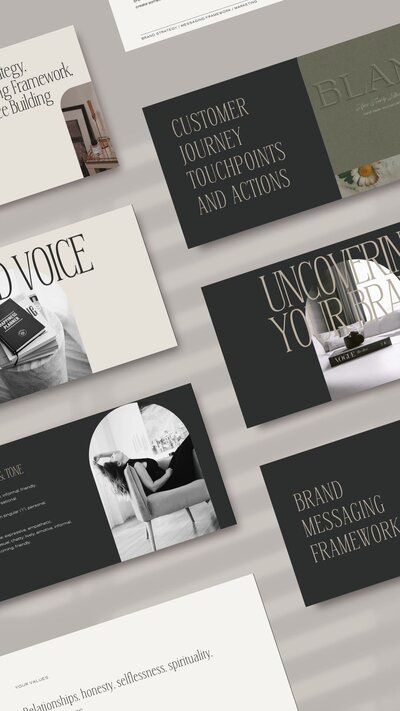
Now that I have all that info it’s time to make sense of it. So I map out every single customer touchpoint from the moment someone becomes aware of the problem all the way through to becoming a repeat customer.
So basically I map what they’re thinking at each stage:
• Awareness: “Ugh, I know my website isn’t working but I don’t know why”
• Interest: “Maybe I need professional help with this”
• Consideration: “Can I afford a designer? Will they understand my business?”
• Decision: “This person gets me and has results to prove it”
• Purchase: “I’m excited but also nervous about this investment”
• Post-purchase: “Did I make the right choice? When will I see results?”
This is where the customer journey mapping process truly shines!! This is when you start understanding the psychology behind each stage. So here’s your big reminder: THIS IS ABOUT THEM, not you.
As much as it pains us, our brand means nothing if it’s not reaching the right people, the ones who’ll actually value it and need it in their life. What you have to offer matters, so make sure it gets to the right people!
Ok, we’re not done yet, two more steps to go!
Step 4: The friction point hunt
This is where I get really analytical. I’m looking for every possible place someone might get confused, overwhelmed, or just… leave. So we audit as much as we can.
• Are there too many navigation options?
• Is the pricing clear or hidden?
• Do they understand what happens after they hire you?
• Are you speaking their language or using industry jargon?
These friction points are conversion killers, and most businesses have no idea they exist.
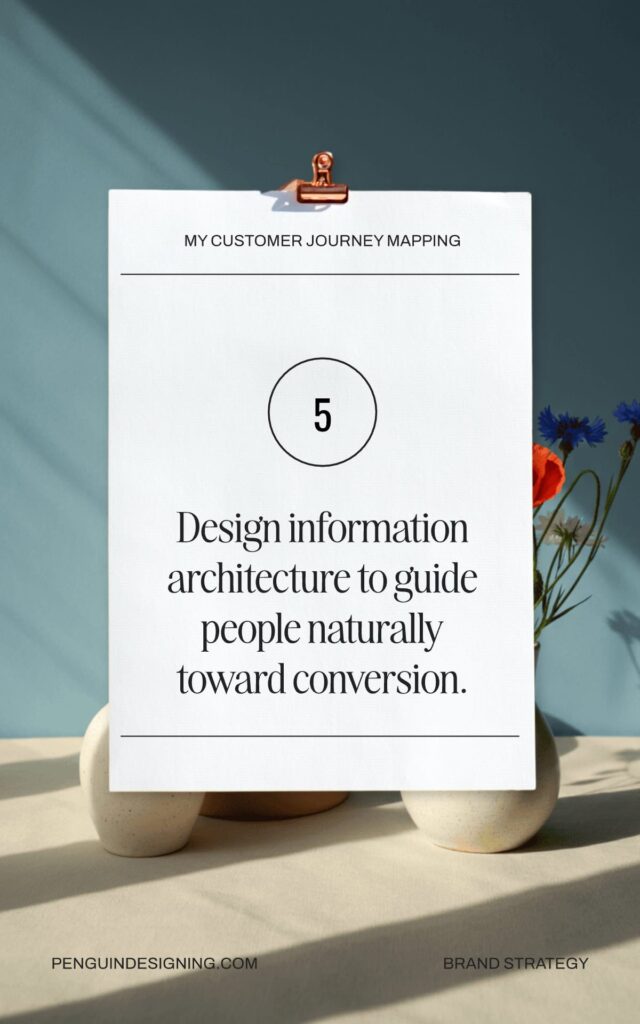
Step 5: The strategic solution design
Only after all this research do I start thinking about website structure, messaging, and design elements.
Because now I know:
• Exactly what their audience needs to hear at each stage
• Which objections to address and when
• How to position the business as the obvious choice
• What information architecture will guide people naturally toward conversion
Let me give you an example…
If I had a client whose audience was primarily busy moms starting online businesses.
And if through my customer research process, I discovered they were doing research late at night on mobile devices, often while multitasking.
This would completely change our typical development approach! Instead of a detail-heavy homepage, I would suggest we created a scannable, mobile-first design with clear progression steps and “quick start” CTAs throughout.
See how the research influences the results? That’s why I don’t lift a single pencil to sketch the design until this is done.
Don’t miss this about your customer journey mapping
Most businesses skip the research phase and jump straight to “what do we want to say?” instead of “what does our audience need to hear?“
But when you truly understand your customer’s journey — their thoughts, fears, and decision-making process — designing becomes so much easier.
Every element serves a purpose, every section moves them forward, and conversion happens naturally.
This essentially comes down to one thing: understanding how your people think makes selling about serving, not convincing.
Your customer journey mapping action plan
Let me say this loud and clear: you don’t need fancy tools to get started. You need a systematic approach!
Want to map your own customer journey?
Here’s where I suggest you start to look att:
Audit your current customer touchpoints (where do people interact with your brand?)
Research what your customers are actually saying (not what you think they’re saying)
Map the emotional journey alongside the practical steps
Identify friction points where people get stuck or leave
Design solutions that address each stage strategically
Ready to master your customer journey mapping process?
If you’re thinking “Ingrid, this sounds amazing but I need a template and a bit more info to get it rolling,” I get it. The process I just shared is the foundation, but there’s so much more to creating a customer journey that actually converts.
My Offer Synergy course includes my customer journey mapping template plus the framework I use to make strategic website decisions.
You’ll get the exact spreadsheets I use to track everything, plus step-by-step guidance on how to implement each stage.
The clearer you are, the less energy you spend “figuring it out”
Map your customer journey best offers for only $27.
When you create your very own Customer Journey Offer Tracker following my lead inside Offer Synergy, you’ll easily map your unique customer journey and track your timely, relevant offers that help boost conversion rates and bring more revenue in the door.
Ready to turn your website into a powerhouse lead generator even on a saturated market?
My free guide, "5 High Converting Website Tricks", gives you key strategies to create a website that showcases your brand, attracts your ideal clients, and is ready to convert them into paying customers.
I design strategy-led brands and Showit websites that confidently represent you.
I’m a designer with a magic touch for monetizing websites. I’m also a tea-lover, dog momma, Ravenclaw, INFP and 2w3 (for all you personality-test nerds like me).
I’ve also been called a Showit website expert (been with them since 2013), and a sucker for understanding customer journeys, brand psychology, and consumer and sales psychology. My clients have some pretty cool results after working together, things like doubled shop conversions, booked-out services in weeks, and increased monthly revenue, among other cheer-worthy celebrations.