Every page in your Showit site has an SEO Settings tab waiting in the right-hand panel, and it is SO easy to skip it when the design is the fun part… I get it, I do!
So here’s the screen-by-screen walkthrough: what to fill in, where to click, and what to leave alone. Do it page by page and every page on your site can tell Google what it is!
And if you’d rather have someone go through your whole site and tell you what your five priority pages should be found for, that’s what my SEO Visibility Blueprint is for. Start here though!
How do you set up SEO in Showit?
To set up SEO in Showit, give every page its own page title, meta description and share image in the SEO Settings tab, set one H1 per page through the Text Tag in Text Properties, describe every image in its alt text, and keep image files small. Then check Google Search Console to see which searches your pages appear for.
Here’s each one, in the order I’d do them…
Page titles, descriptions and share images
Select a page in the left panel, open the SEO Settings tab in the right panel, and you’ll find the page title, the meta description and the share image. Showit does not copy your homepage settings across the site, so EVERY page needs its own, or a blank one leaves Google to guess.
The page title
The title tag is the clickable headline in Google’s results, so it should describe the page accurately and briefly. In August 2026, Showit’s own blog recommended keeping it under about 60 characters, leading with what the page is and who it’s for.
The structure I use: Primary Keyword – Secondary Keyword | Brand Name. You go from uber specific, to less specific, and end with your brand or website name.
Skip titles that are just a list of keywords, or the same word in five variations. That can actually get you into trouble with search engines.
This is the little blurb under your title in the results. Showit’s blog suggests about 150 characters. It doesn’t directly affect your rankings, but it does influence whether someone clicks, so write it for the person reading it.
The share image
It’s the preview picture when someone shares the page in a text, a social post or a DM. Pick one on purpose for every page!
The page URL
Inside Showit, your page name turns into the page URL, so be careful with what you call it. URLs are a teeeeny piece of SEO, so name the page what it is and don’t lose sleep over it!
One H1 per page, set on purpose
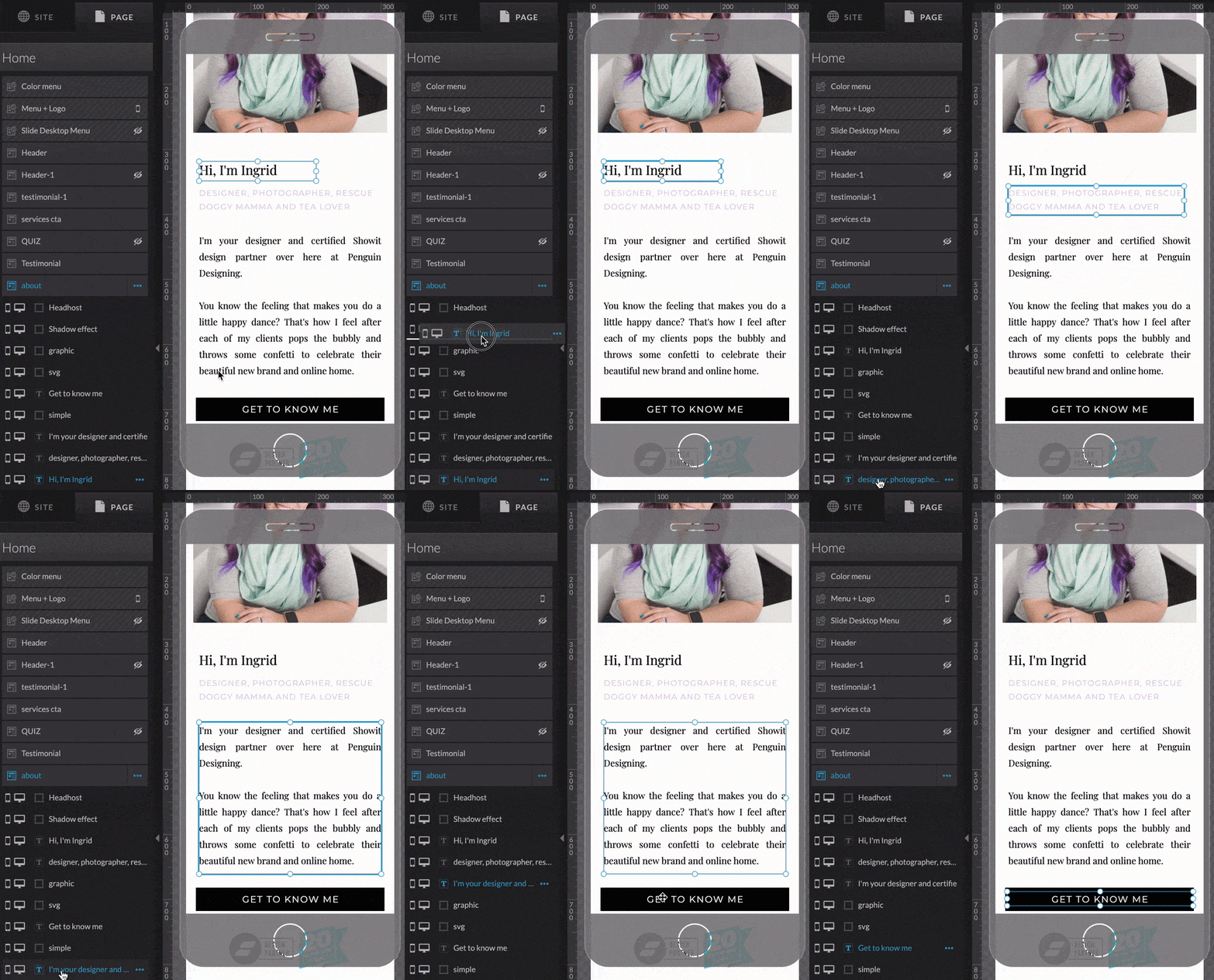
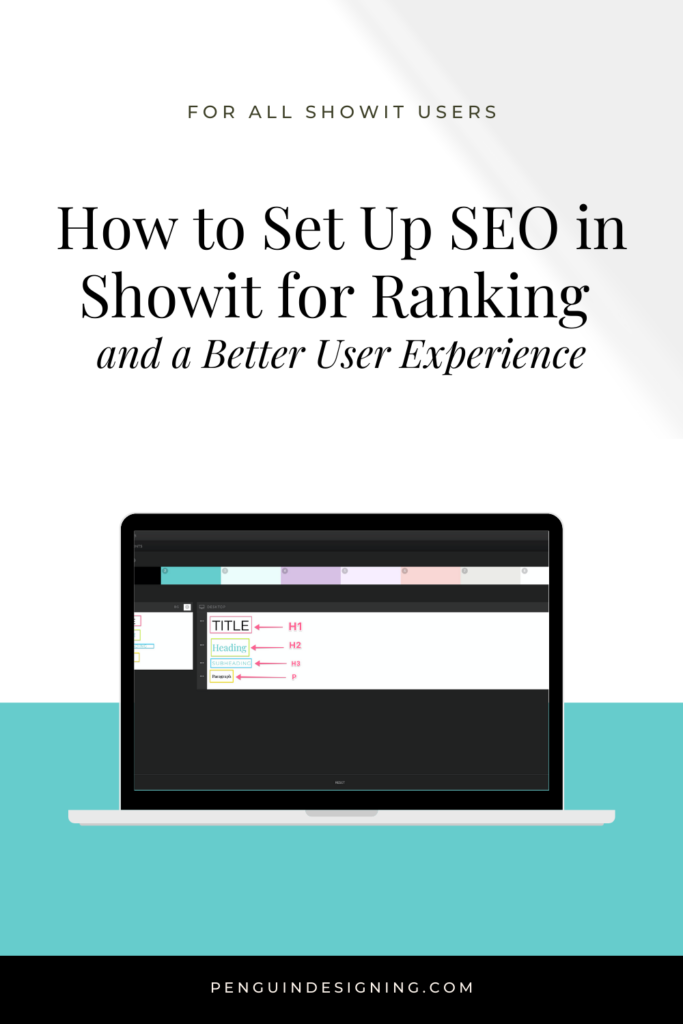
This is one of the most important things you can carefully do to improve your SEO in Showit. Your website is built with tags that follow the text styles in your Design Settings: Title, Heading, Subheading and Paragraph. Showit sets the tag from the style: Title becomes an H1, Heading an H2, Subheading an H3, and Paragraph a plain p tag.
Here’s the catch… a Title style used just because it looks good can give one page several H1s, and a real heading styled as Paragraph can leave a page with none. To fix it, select the text box, open Text Properties and change the Text Tag yourself, then style the text separately so it still looks the way you want.
These are the tags to be mindful of:
H1: the title of the page
H2: a header or subsection on a page
H3: a subheader, a section within the H2
P: your body copy
Nav: your links (like your menu)
Div: purely decorative accents, no real content value
Think of H tags like writing a book: your H1 is the title of the book, the H2s are the chapters, the H3s are the sub sections inside a chapter, and the P is the rest of the story, the actual words.
It takes some time and practice to set your tags up this way… but once you do, the layout of your site will be much more attractive for readers and search engines alike!
Hidden elements and the mobile canvas
Two checks that are easy to forget… First, anything you hide on mobile or desktop is still in the page code, so delete what’s hidden on both views and keep a duplicate only where your mobile and desktop layouts truly need it.
Second, look at every page on the mobile canvas before you publish: the headings, the tap targets and any hidden content. Then preview it on a real phone. Showit’s blog covers both in its list of six settings that can hurt your rankings.
Name your canvases and order your layers
It’s a best practice to rename your canvases (the sections inside each page in Showit) and give them short, descriptive names: Header, Bio, Info, CTA, etc… It keeps the editor easy to move around in.
Layer order matters too, and what’s right depends on which Publish Engine your site is on. Look for the green check badge beside your design name: if it’s there, you’re on the updated Publish Engine, and Showit’s October 5, 2026 post says your layers now match the order in Showit. So order them the way the page reads: if the H1 is at the top of your hero, it sits at the top of that canvas’s layers.
If you’re still on the original Publish Engine, it’s the other way around… the code comes out backwards. So the H1 (your hero headline) goes at the very BOTTOM of that canvas’s layers, and the page reads in the right order when it’s published. Showit has a quick assist for moving layers, too!
It also helps people using a keyboard to move around your page and between the fields of a contact form. Accessibility is important, don’t forget that.
Thinking of upgrading? Go to Site Settings, open Upgrade, and try the new engine in Beta first, with a preview. A site built the old way needs its layers reordered to match, and since layer order also decides what sits on top, a box can end up covering content after a reorder. Look at every page before you publish.
Want to save this post?
Just add your name + email and I’ll send it straight to your inbox! Plus, you’ll also receive a weekly moneymaking move, just like this one.
Alt text and image size
This goes beyond SEO, it’s for your visitors and for accessibility. To please search engines and visitors with a fast loading site, you need to optimize your images. Showit optimizes images when you upload, but you can help and do more while keeping quality.
Showit’s blog recommends keeping image files at 500KB or less, around 300KB if you can, and compressing before you upload. Blog images are different: they live in WordPress, so you manage those separately.
I always export at 3500px on the long side, then I run the files through JPEGmini and ShortPixel (TinyPNG works too). That gets a 3500px image to about 500KB, most times very close, which is what I use for backgrounds. For anything smaller, a 2500px export is plenty. I don’t go under that, because it can start to look blurry instead of crisp. If you want to try ShortPixel (which is free by the way) you can use this link and receive 100 images per month from the free plan + 100 one-time credits, because you got invited.
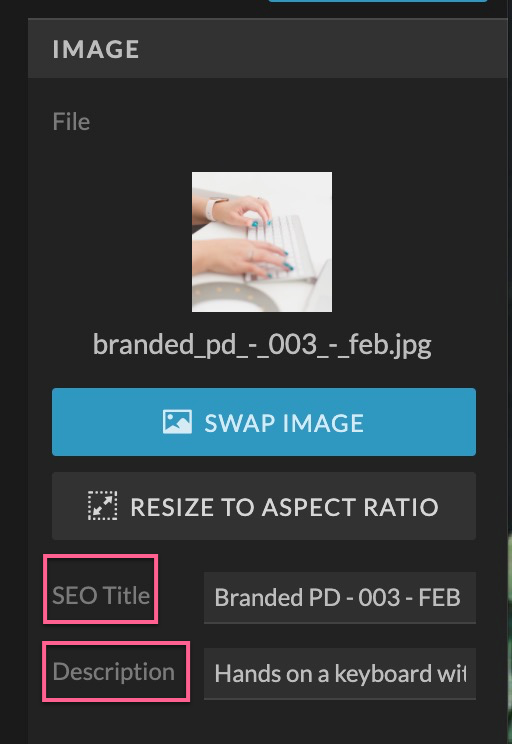
The “SEO title”
This should be unique for every image on your site, and it doesn’t need to be stuffed with keywords, it is just the file name, so yes you can name it somewhat related to the image but remember it must be unique, so even just adding “02” “03”, etc.
Alt descriptions
This is a simple one most people miss. You need to add an alt description for every single image on your site for 2 reasons: Search engines are READING your site, so an image with no alt description? Can’t be read. And the most important reason: being accessible. To stay ADA compliant, and to be a good human, you need to make your website accessible. In Showit, the image’s SEO Description is its alt text.
In the alt description, you should enter a simple succinct description of what is in the image.
Literally. Imagine you are describing it to a blind friend, that’s how you should type it. If you happen to be able to incorporate keywords in a natural conversational way, go for it. Otherwise? Don’t do it. This is not a keyword stuffing place.
Real content beats an empty page
I can’t stress this enough, but good content is what will drive your SEO further. When you can conversationally add the keywords you want to rank for while providing value for your visitors, you create a balanced website that pleases the SEO god and gives your people the best experience, while you deliver value and convert them from passive readers to hot leads.
You will have a better user experience with real content that people want because they are looking for it!
WITH SEO POWER COMES TRAFFIC…
Ready to turn your website into a powerhouse lead generator even in a saturated market?
My free guide, “5 High Converting Website Tricks”, gives you key strategies to create a website that showcases your brand, attracts your ideal clients, and is ready to convert them into paying customers.
Download now for free!
Bonus look at Yoast for blog pages and posts
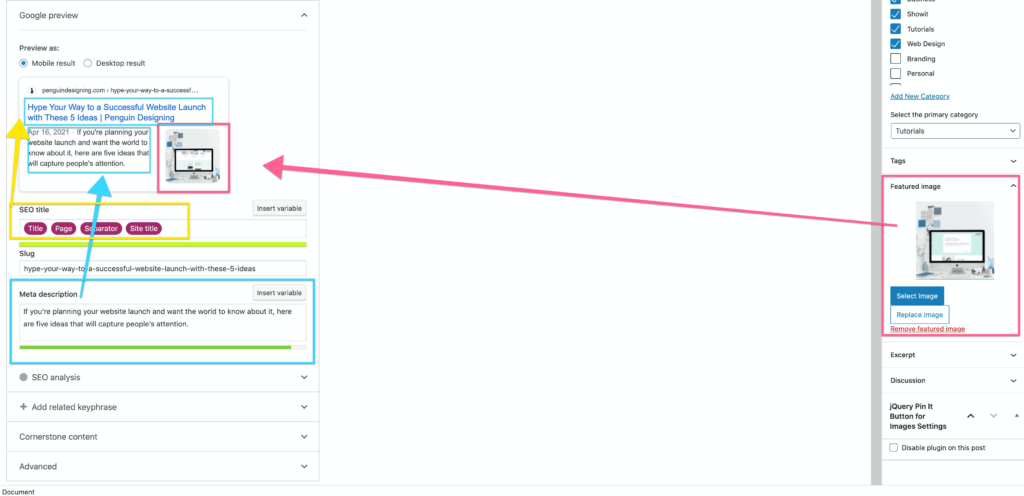
To optimize your blog posts and custom blog pages, scroll to the bottom of the page and you’ll find the Yoast section. Here you can add your page title and meta description, and even see how it would be displayed on searches! On the right side, don’t forget to add your featured image. This can appear in search results too.
You want to make sure you are optimizing your content and putting it out there in the right way. So take some time today and find what works for your workflow when working on your site so you can have the best out there.
Ultimately, my number one tip?
Focus on Quality Content. Align your message to your brand and audience. That will help you rank even faster because you are providing value that your people are already wanting!
Frequently asked questions
How long should a Showit page title be?
A Showit page title should be under about 60 characters, according to Showit’s own blog (August 2026), and it should lead with what the page is and who it’s for. Put your brand name at the end, after a pipe.
How many H1s should a Showit page have?
A Showit page should have ONE H1. Showit sets the text tag from the text style, so a Title style used for looks can create several. Check Text Properties on each text box, set the Text Tag yourself, and use H2s and H3s for the sections below.
How big should my images be in Showit?
Showit’s blog recommends keeping image files at 500KB or less, with around 300KB as the ideal, and compressing them before you upload. Showit optimizes images placed on pages, but blog images live in WordPress and need managing separately.
When the settings are right and the right people still aren’t finding you
And if it IS showing up, but for searches your buyer would never type… that’s a different problem. The settings tell Google what a page is. They don’t decide what the page should be found for, and that part comes from your buyer, your offers and your brand strategy.
Here’s what it looks like when it works, from two photographers I’ve worked with.
Take Kira Jeffrey Photography. Today she ranks on page one for “charlotte newborn photography”, one of the searches her ideal newborn clients type (position 5 in my Ubersuggest check on October 19, 2026). That ranking backed up the price increase she made while we worked together.
And Jennifer Denton Photography: she added a brand photography service in San Antonio, and four weeks after launching it she was ranking #1 on Google (I tracked it for those four weeks to make sure it wasn’t a fluke). Years later, she’s still on page one for “san antonio brand headshots”.
That’s the work behind my SEO Visibility Blueprint. I go through your whole Showit site and focus on your five priority pages: how your buyers search, which search each of those pages should be found for, and the page title, meta description and headings each one should carry. You get a keyword map and a roadmap, ready to do yourself, hand to your team or hand back to me!
This post contains affiliate links. If you use them I get a kickback benefit with no extra cost to you. I only promote tools I love and use on my own business.
Want more? These are for you:
filed under:
I'm Ingrid, welcome! I'm a branding designer + Showit Design Partner, doggy mamma, and tea drinker.
Ready to turn your website into a powerhouse lead generator even on a saturated market?
My free guide, "5 High Converting Website Tricks", gives you key strategies to create a website that showcases your brand, attracts your ideal clients, and is ready to convert them into paying customers.
I design strategy-led brands and Showit websites that confidently represent you.
I’m a designer with a magic touch for monetizing websites. I’m also a tea-lover, dog momma, Ravenclaw, INFP and 2w3 (for all you personality-test nerds like me).
I’ve also been called a Showit website expert (been with them since 2013), and a sucker for understanding customer journeys, brand psychology, and consumer and sales psychology. My clients have some pretty cool results after working together, things like doubled shop conversions, booked-out services in weeks, and increased monthly revenue, among other cheer-worthy celebrations.