Assistive AI vs. generative AI: the difference your clients deserve to know

Not gonna lie, this one’s been sitting in my drafts for a while, because I have a lot to say about it and I wanted to get it right before I hit publish (I know it can offend so many people at once…)
To give you a little context, a client of mine (booked, contract signed, project already underway) emailed to ask if I was actually going to write her website copy myself. She’d read my AI disclosure clause, and it left her with doubt instead of the trust it was supposed to build. This is the second time now that a client has read that exact clause and come back with some version of “wait, so are YOU doing the copy?” A clause I wrote to reassure people is doing the opposite 😬. That’s what that made me sit down and finally write this.
So let’s talk about all of it: the difference between assistive and generative AI (a difference almost noooobody makes), why that difference decides whether you can actually trust what a professional hands you, and what’s really happening when a detector flags something as “AI” that a real human wrote every word of.
Let me explain it in colors!
If you know what the color purple looks like, and you know that mixing red and blue gets you there, you can ask AI to give you “purple” and know immediately whether it got it, right? You’d KNOW, because you know how purple is made and what it’s supposed to look like.
Now picture a craft store. You’re standing in front of paint swatches with the color name hidden, and you have no idea what’s actually in the container. You ask AI. You’d trust it, because you don’t know better and it sounds like it has access to everything (at this point it does…)
That’s the EXACT position most business owners are in with branding, websites, copywriting, and strategy. You can ask AI to hand you fresh sales page copy, a new site design, a whole brand strategy. If you don’t know how it should look, if you don’t know what makes YOUR audience actually react, if you don’t know what converting copy sounds like for your specific market, you’re going to take whatever comes out and proudly display it.
A professional uses AI differently because they already know what the end result is supposed to look like.
They can use it to assist with the tedious parts (spellchecking, catching a paragraph that’s run too long, flagging when a page is short on headers, checking the pain-to-benefit ratio against the actual goal) precisely because they’d catch it if the output was wrong!! The first touch and the last touch are still, EVERY SINGLE TIME, all human.
AI is missing all the context, the nuance, the deep understanding about YOUR brand. You can run all the “tests” and “audits”… but you will continue to shoot yourself in the foots if AI is just looking at the surface level and giving “deep insights” based on the front-facing-no-deep-context alone.
Everyone else takes it at face value and screams from the rooftops that they’ve found the best thing ever, with zero way of knowing whether it will actually work for their business. You need to know the rules to break them. You need to understand how something is supposed to work before a tool like AI can help you do it better instead of just faster.
I wrote a bit about this same idea from the marketing side a while back, when I looked at how AI is changing email summaries (also assistive, not generative, and also only useful once you know what a good email is supposed to do).
How I actually use it (and why I’ve disclosed it for years!)
I am not anti-AI, ot even close. I use it constantly in my own business, I went from spending 2 to 3 hours a day on my inbox to 2 to 3 hours a WEEK on it. It’s been in my client contracts for a couple of years now, mostly because I talk a mile a minute and love dictating with Wispr Flow (best little buddy for anyone who speaks a thousand words a minute, if you haven’t tried it). I’ll brain dump a whole document, then run it through Grammarly to catch mistakes, then run it through Claude to check I’ve covered everything I said I’d cover, because I’ve built my own skills off my own knowledge and my own process. Instead of me combing back through everything I just wrote, it does that pass in a tenth of the time.
I’ve disclosed this in my contracts the whole time, and I think it should be a must for everyone doing this kind of work. People need to stop being cagey about when and how they’re using AI. There’s a BIG difference between being assisted by AI (like having an intern who already knows how you like things done, helping you execute faster) and using AI to generate something you don’t actually know how to do yourself.
Why a trust clause started creating doubt instead
I’m glad my clients read that clause. My contract also covers project pauses and what happens if someone goes quiet mid-project, so nobody gets to say later they didn’t see it. Clients actually reading their contracts is a good thing!! The clause just has to say it s little different so it was easier to understand.
We trust the professionals we hire. If I need to see a doctor, I’m going to trust them. That trust is why the paint color example problem above matters so much, because I’ve watched so many “professionals” take an AI-generated strategy at face value and hand it straight to their own clients (insert the BIGGEST EYE ROLL… I have screamed at my screen, I have sat with that for far too long). Blind leading the blind, and it makes me furious, because the client had no way to know the difference.
Where the line actually is
So where’s the fair-use line, in practice? A copywriter who focuses on email and funnels using AI to help brainstorm 10 or 20 subject lines is completely fine. Everything past that point (the actual words, the strategy, maybe even the seed idea behind the winning subject line) is still coming from her. That’s a “help me brainstorm,” not a handoff and “generate for me”. It’s the example I keep coming back to when I want to explain fair use without sounding anti-AI, because I’m not!
If you’re the one hiring, not the one doing the work
If you’re a business owner trying to figure out whether you should use AI for your own branding, or whether the person you hired is using it responsibly, here’s the my 2-cents: it depends entirely on which kind you’re getting.
Ask the professional you’re working with a direct question: what’s coming from you, and what’s coming from a tool? A good answer sounds specific, “I use it to check my headline count and catch typos, everything else is mine,” not defensive, and definitely not a shrug. If the answer is vague, or if the deliverable reads like it could have been handed to anyone in your industry rather than built for YOUR audience specifically, that’s your answer. You don’t know what good looks like yet, so you can’t tell if what you got is actually good, or just confident-sounding.
This is why hiring someone who already knows your market, who’s done the audience research and the voice-of-customer work, matters more now than it did five years ago, not less. AI made it easier than ever to produce something that LOOKS finished. It didn’t make it any easier to know whether it’s actually right for your business.
If you’re the one doing the creative work
And if you’re a designer, copywriter, or strategist reading this, nodding along: disclosure isn’t the scary part. Vague disclosure is. “I may use AI tools” tells a client nothing about what actually happens to their project. Specific disclosure, the kind that lists the task (grammar, structure checks, brainstorming) and draws a hard line around the parts that stay fully all yours, is what actually builds trust instead of eroding it.
The client moment I mentioned earlier taught me that a disclosure clause written from a legal mindset and a disclosure clause written to actually reassure someone are not the same thing, even when they say almost the same thing. Write yours like you’re explaining it to a friend over coffee, not defending it to a lawyer (but be sure to have the lawyer-crafted one there too! We need to stay protected).
What an AI detector actually proves (spoiler: not much)
A client could run finished copy through an AI detector, or eventually spot a watermark on something that passed through a model at some point, and land on “oh no, you didn’t actually write this.” When what really happened is that HER OWN writing passed through a tool for grammar, organization, etc (the same way mine does). Passing human text through a tool can attach an AI label to work that is entirely human in origin.
And the detectors themselves are nowhere near as reliable as people assume. A peer-reviewed study out of Stanford, published in the journal Patterns, ran real, human-written TOEFL essays from non-native English speakers through several popular AI detectors. The detectors misclassified them as AI-generated at an average false positive rate of 61.22%, with 89 of the 91 essays flagged by at least one detector. The same detectors got it right on essays written by native English speakers, with a false positive rate of just 5.19%. Same tools, same task, wildly different result depending on nothing more than how the writer happened to learn English. If a detector can get it that wrong in a controlled study, it can get it wrong on your website copy too. (Source: Patterns, Cell Press)
And just for funsies, let me show you what two different AI detectors did on my blog post about website footers:
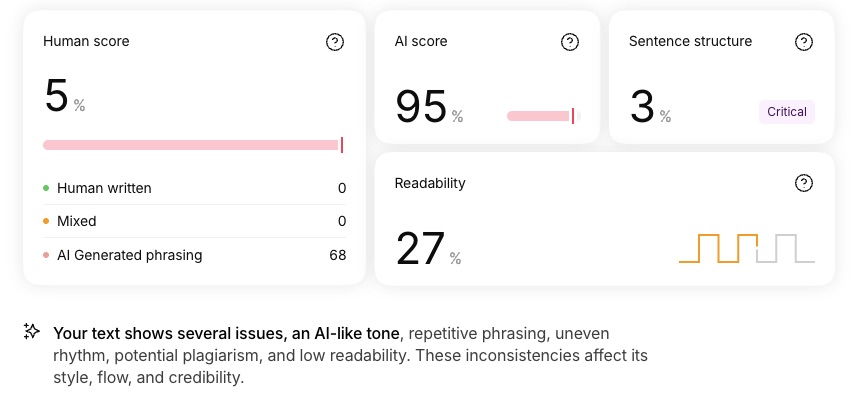
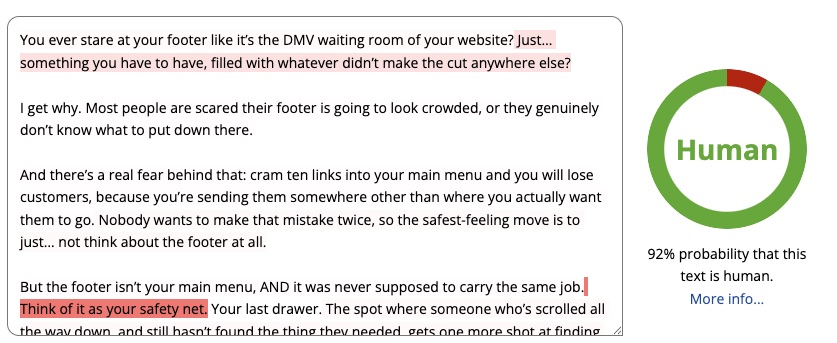
Same blog post, one scoring 5% human and the other scoring 92% human when it is 100% human. Same human content dictated straight to the paper with AI separating the headers and checking for spelling and grammar. If this isn’t the era where you have to be skeptical of everything, I don’t know what it is. And I absolutely hate that so many AI detectors pry on people’s fears for their own content, for what they’re being fed. I get it, but so far, if the content is good and you’re learning something from a trusted source, enjoy that, rather than worrying how much of it was human and how much was an AI helping add commas.
What a good AI clause should say
For the designers and copywriters reading this and nodding along: my old clause front-loaded “Designer may utilize AI technologies,” followed by four paragraphs of benefits. Ew… It read like “this business uses a lot of AI” before it read like anything reassuring. I rewrote mine to lead with plain-language authorship instead, something closer to: I use AI-assisted tools for tasks like grammar review, organization, and internal quality checks. Every strategic decision, every piece of copy, and every design choice comes from me. Say what you actually do, in that order, before you get anywhere near permissions and benefits language.
I say this much to a client on this topic because I care, a lot, about working in a way that makes you truly great at what you do, with real ethics behind it (running a business should be ethical, not just on AI use!)
If you want a gut check on where your own website, brand voice, or offers stand before anyone ever runs anything through a detector, grab my free Website Optimization Checklist and see how it actually holds up against best practice, not against a guess.
The takeaway
Ok, stepping off my soapbox. You need to know what good looks like before AI can help you, whether you’re the one using it or the one hiring someone who does. That’s the whole point of keeping it ethical and it’s why disclosure has to teach instead of just cover you legally.
A few things I’d leave you with, if you take nothing else from this:
- Assistive AI (spellcheck, structure, brainstorming) speeds up work you already know how to judge. Generative AI hands you an output you can only evaluate if you already know what good looks like for your specific business.
- A disclosure clause that names the actual task beats a vague “may utilize AI technologies” every single time. Specific builds trust, vague creates doubt, even when the underlying practice is identical.
- An AI detector flagging something tells you almost nothing on its own. Treat a flag as a question to ask, never as a verdict.
If you want a second set of eyes on whether your own brand, website, or offer suite is landing the way it should, before anyone runs anything through a detector at all, that’s what my Brand Strategy Experience is built for: a real human who already knows what good looks like for your specific market, going through it with you.
This is one I feel strongly about, so thank you for sticking with me through the whole thing 💜. If you’ve got a story of your own, an AI detector false positive, a client who asked you the same question, I’d truly love to hear it. You can find me at @penguindesinging on Insta!
Sources: GPT detectors are biased against non-native English writers, Patterns (Cell Press), 2023
filed under:

I'm Ingrid, welcome! I'm a branding designer + Showit Design Partner, doggy mamma, and tea drinker.
get to know me »




P.S. Found value in this post? You can always drop a little something in the treat jar — this goes toward treats for my pup (yes, Yui loves it) and fueling more great content! 💜
Ready to turn your website into a powerhouse lead generator even on a saturated market?
My free guide, "5 High Converting Website Tricks", gives you key strategies to create a website that showcases your brand, attracts your ideal clients, and is ready to convert them into paying customers.
Download now for free!
Featured Case Studies
Jen Wagner Co
Shopify to showit with Woocommerce shop Migration
TIQUE
Custom Brand + Showit Website + Shop

Blanc Salváge
Brand Strategy + showit Shop Design + Copywriting
Revitalized Health & Wellness Counseling
Custom Brand + Website

Wordfetti + Wordshop
showit Website + shop Design & Development

Editorial Stock Images
showit shop + Multi-level Membership


Amy Posner
Brand Strategy + Custom Brand + Showit Website

Our clients lead their industry.

Hi I’m Ingrid
I design strategy-led brands and Showit websites that confidently represent you.
I’m a designer with a magic touch for monetizing websites. I’m also a tea-lover, dog momma, Ravenclaw, INFP and 2w3 (for all you personality-test nerds like me).
I’ve also been called a Showit website expert (been with them since 2013), and a sucker for understanding customer journeys, brand psychology, and consumer and sales psychology. My clients have some pretty cool results after working together, things like doubled shop conversions, booked-out services in weeks, and increased monthly revenue, among other cheer-worthy celebrations.